About Agaricus brunneofibrillosus Kerrigan
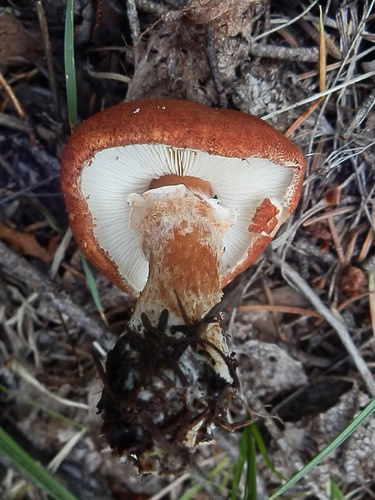
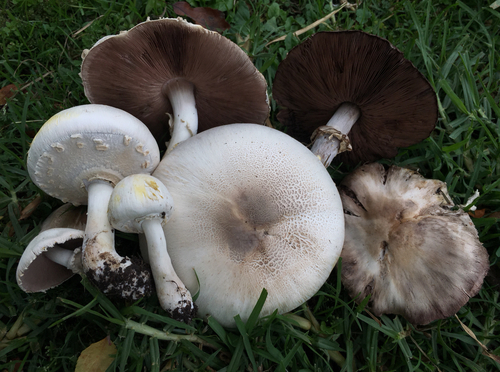
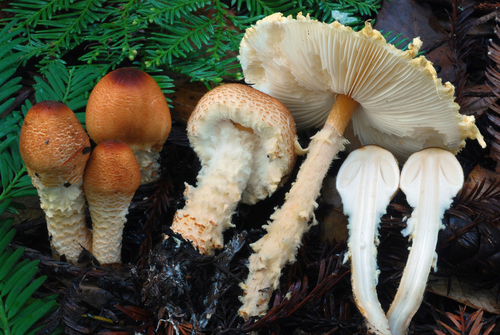
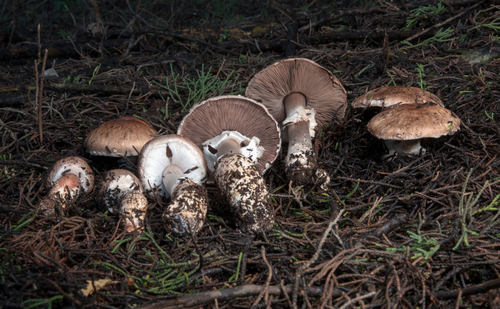
Agaricus brunneofibrillosus Kerrigan has a cap that starts convex before flattening, reaching a diameter of 5–13 cm (2–5 inches). The cap surface is dry and smooth, ranging in color from reddish-brown to coco-brown, with silky fibrils, sometimes flattened scales, and often a slight umbo. When the mushroom reaches maturity, the fibrils usually darken to walnut brown. The flesh is white and does not change color when tested with KOH. If bruised or injured, the flesh turns bright red within 30 seconds, and later fades to brown. The odor of crushed flesh is mild and mushroomy. The gills are initially cream-colored, pale pinkish, or pinkish-gray before turning brown, and finally dark chocolate-brown as spores mature. In mature specimens, the gills are not attached to the stem, are packed closely together, and have little space between them. The stem measures 4–15 cm (1+1⁄2–6 inches) long and 1.5–2.5 cm (1⁄2–1 inch) thick, and usually has an enlarged or bulbous base marked with one or more coca-brown bands. The stem is firm, smooth, and does not have the scales found on the cap; it is white, but may discolor to bright red or dingy brownish as it ages or after handling. The partial veil is membranous and white, and forms a thin skirt-like ring on the upper portion of the stem. The spore print is chocolate brown. The smooth, thick-walled spores are elliptical, and typically measure 5–6.5 by 3.5–4 μm. Cheilocystidia, which are cystidia located on the gill edge, are scattered, club-shaped to cylindrical, and grow up to 22 by 7 μm. Fruit bodies of this species appear in late fall and winter, growing scattered or in groups in deep leaf litter under Monterey cypresses, and rarely under other types of trees. This mushroom is found in coastal California, and is most common in the Monterey and San Francisco Bay Areas. This species is an edible mushroom.