About Agaricus augustus Fr.
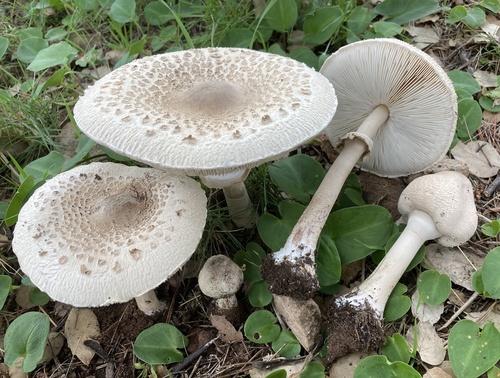
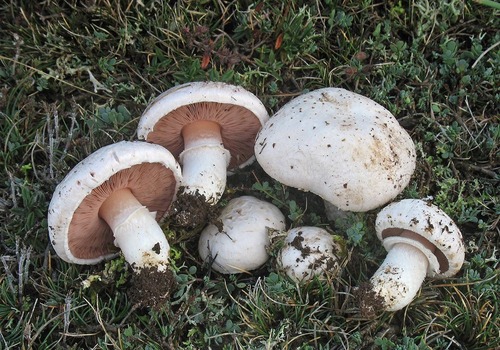
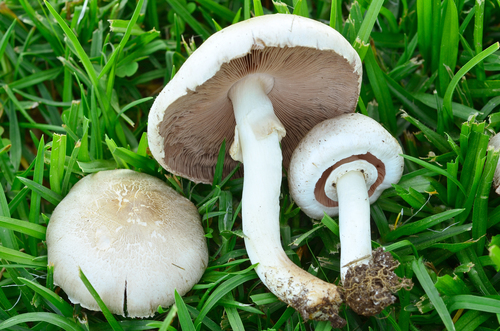
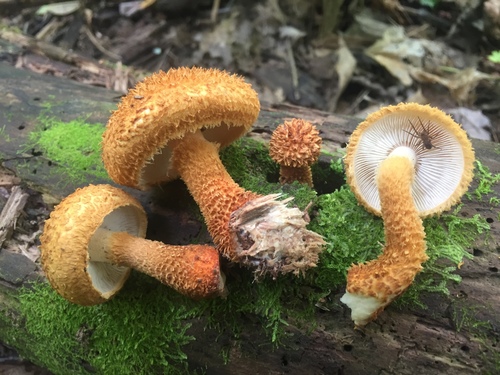
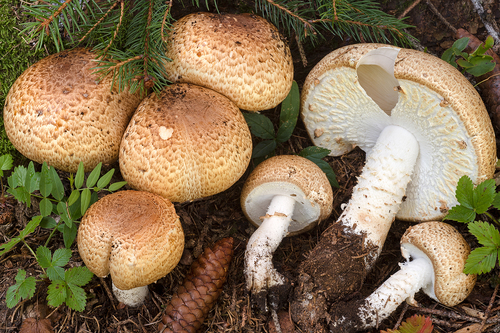
Agaricus augustus Fr. produces large, distinctive agaric mushrooms. In the button stage, the cap is hemispherical; it expands as it grows, becoming convex before finally flattening out, and reaches 8–30 cm (3–12 in) in diameter. The dry cap cuticle has a white to yellow background, densely covered in concentrically arranged brown scales. The thick, firm, white flesh may turn yellow when bruised. The gills are crowded, starting out pallid, then turning pink and finally dark brown as the mushroom matures. They are free, meaning they do not attach to the stem. Immature specimens have a delicate white partial veil with darker warts, that stretches from the stem to the edge of the cap. The stem is club-shaped, measuring 7–30 cm (3–12 in) tall and 2–6 cm (3⁄4–2+1⁄4 in) thick. In mature mushrooms, the partial veil tears and leaves a hanging ring on the stem. Above the ring, the stem is smooth and ranges from white to yellow; below the ring, it is covered in many small scales. The stem's flesh is thick and white, and sometimes has a narrow hollow in the center. The base of the stem extends deeply into the growing substrate. This mushroom has a strong, sweet odor similar to almond extract, marzipan, or maraschino cherry, caused by the presence of benzaldehyde and benzyl alcohol. Its taste is described as not distinctive. It gives a positive red reaction in Schaeffer's test, and the cap cuticle turns yellow when a 10% potassium hydroxide (KOH) solution is applied. Under microscopic observation, spores are ellipsoid, characteristically large, measuring 7–10 by 4.5–6.5 μm. The basidia are 4-spored, and the spore mass is chocolate-brown. Agaricus augustus has a widespread distribution, found across Europe, North Africa, Asia, and North America. It grows in deciduous and coniferous woods, gardens, and along roadside verges. It is a terrestrial saprotrophic fungus, meaning it gets nutrients from decaying dead organic matter, and produces fruiting bodies on humus-rich soil. The species is well-adapted to grow near human activity, and also grows on disturbed ground. In Europe, it fruits in late summer and autumn; in North America, it can be found from April to December. A. augustus is known to bioaccumulate the heavy metal cadmium; one Swiss study recorded 2.44 mg of cadmium per kilogram of fresh mushroom weight. Other edible Agaricus species also bioaccumulate cadmium, including A. arvensis, A. macrosporus, and A. silvicola. The amount of cadmium accumulated varies widely based on the species, which part of the fruiting body is tested, and how contaminated the growing substrate is. Specimens collected near metal smelters and in urban areas have higher cadmium content. The highest concentration of cadmium is found in the hymenium, followed by the rest of the cap; the lowest concentration is in the lower part of the stem. For most people, this mushroom is a choice edible. It is widely collected for consumption across Eurasia, Canada, the United States, and parts of Mexico.