About Agaricia tenuifolia Dana, 1846
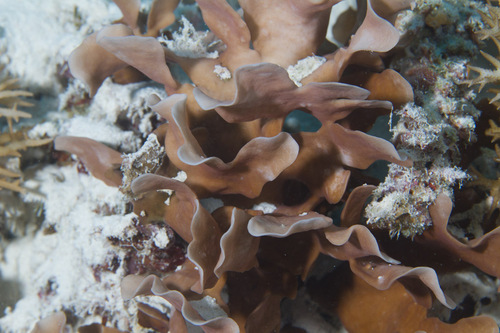
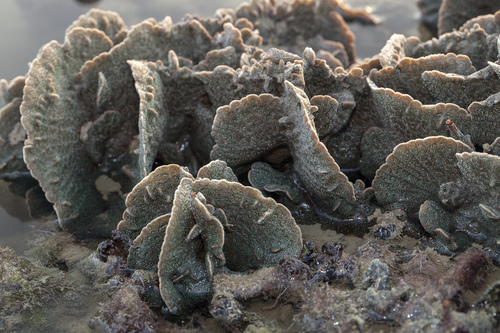
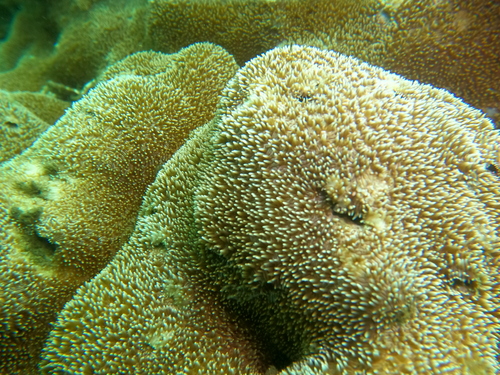
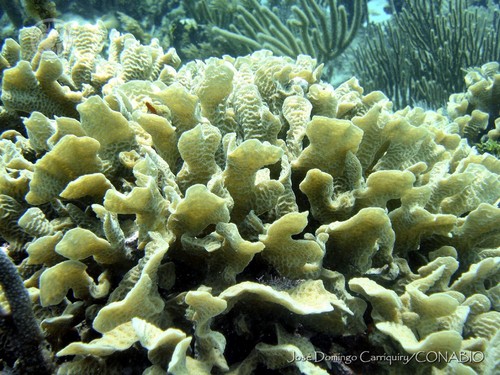
Agaricia tenuifolia Dana, 1846 is a zooxanthellate coral that forms distinct growth forms based on water movement. In sheltered waters, it grows into irregular encrusting patches with many vertical, leaf-like blades. Corallites sit on both sides of these blades, arranged in meandering rows separated by irregular ridges. In areas with stronger wave action, this species may form spherical colonies. Its color is most often pale brown, reddish-brown, or greenish-brown. This coral is native to the Caribbean Sea and the Gulf of Mexico. It is common in the southern part of this range, and less common in the north. It occurs on shallow-water reefs and in lagoons at depths between 1 and 15 metres (3 and 49 ft). A. tenuifolia is a zooxanthellate coral, meaning it hosts symbiotic unicellular photosynthetic dinoflagellates within its tissues. These symbionts use solar energy to produce nutrients that the coral can use, and the coral relies on this source for most of its nutritional needs. The coral also feeds at night, when its polyps expand and extend their tentacles to capture floating zooplankton. A. tenuifolia is susceptible to bleaching: a process where the coral expels its zooxanthellae from its tissues and turns white, which occurs under adverse conditions like excessively high water temperatures. On the Meso-American barrier reef off Belize, this coral readily colonizes open patches of reef. It can be considered a "coral weed" because it blocks other, longer-lived coral species from recruiting to these areas. During a severe bleaching event at this location in 1999, while other coral species later recovered, A. tenuifolia suffered 100% mortality.