About Agaricia agaricites (Linnaeus, 1758)
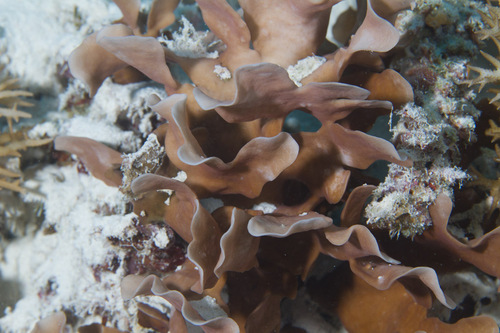
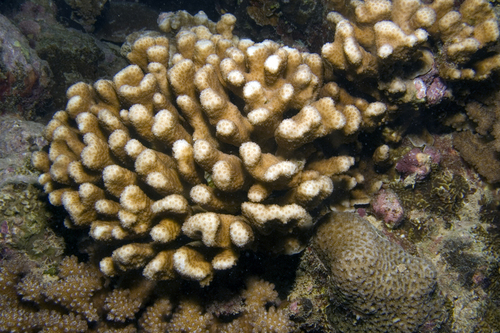
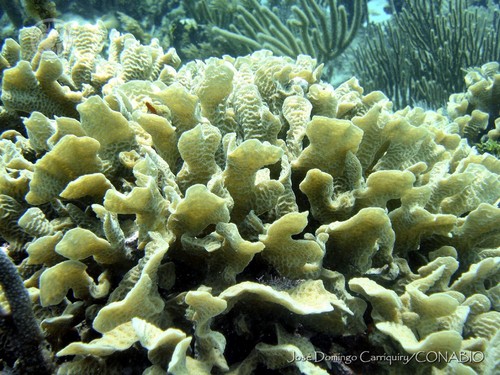
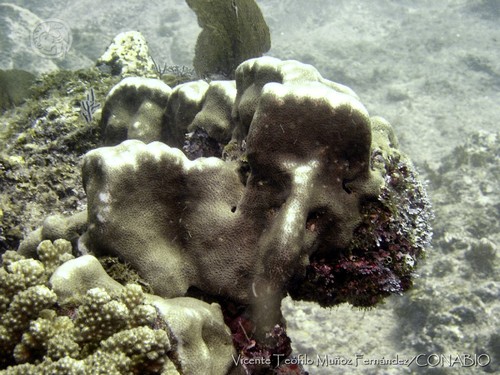
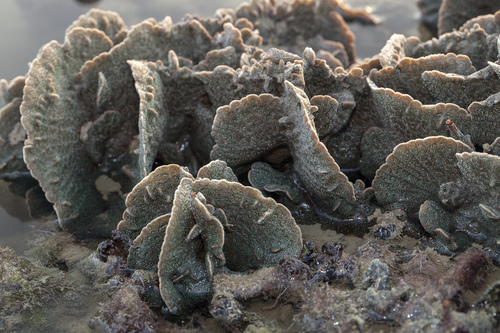
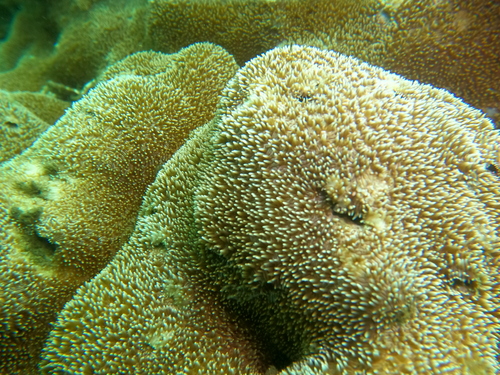
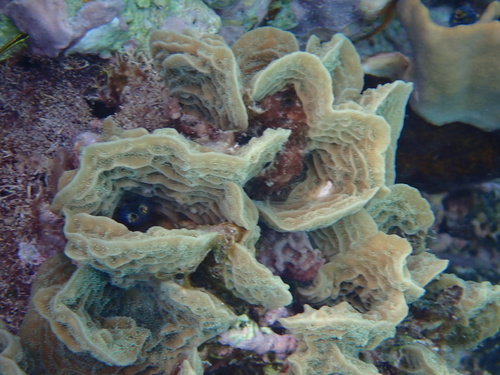
Colonies of Agaricia agaricites can grow in several different forms, but most commonly grow as encrusting sheets with irregular projections, or take on leaf-like or plate-like shapes. New colonies are typically encrusting when they first form, but vertical lobes and sheet-like projections begin to develop even when the colonies are still quite small. Growth form appears to be partially influenced by local water movement and depth. Horizontal plate-shaped colonies usually have corallites on both sides, while vertical growth forms only have corallites on one side. The corallites are mostly arranged in long, meandering rows, with a small number of single corallites, and there are sharp-pointed ridges between the corallites. Each corallite can have up to 36 septa and a central spongy columella. This coral is brown or purplish-brown in color. Agaricia agaricites is native to the Gulf of Mexico, Caribbean Sea, Florida, and the Bahamas. It is also found off the coast of Brazil, on the Fernando de Noronha islands, and at Rocas Atoll. It grows in fore-reef environments, back-reef environments, channels, lagoons, and seagrass meadows, at depths down to approximately 75 meters (246 feet). This is a zooxanthellate coral that hosts single-celled dinoflagellates in its tissues. These symbionts are photosynthetic, and meet 70% to 95% of the coral’s energy needs. The remaining energy is obtained by the coral’s polyps, which expand at night to capture passing plankton. A. agaricites is a small, relatively short-lived species, but new young colonies are very commonly seen. This coral readily recruits to open patches of reef in the western Atlantic, and can be considered a "coral weed" because it contributes very little to reef development. In the United States Virgin Islands, when a sediment plume killed a section of fore-reef, A. agaricites proliferated to provide almost complete cover of the area within just a few years. This species is susceptible to coral bleaching. In 1997, an El Niño Southern Oscillation event caused elevated seawater temperatures off the coast of Brazil. During this event, A. agaricites was the most heavily affected coral species: 80% of individual colonies bleached. When water temperatures returned to normal levels, colonies recovered slowly, but six months later no bleached or dead colonies of the species remained.