About Agapornis taranta (Stanley, 1814)
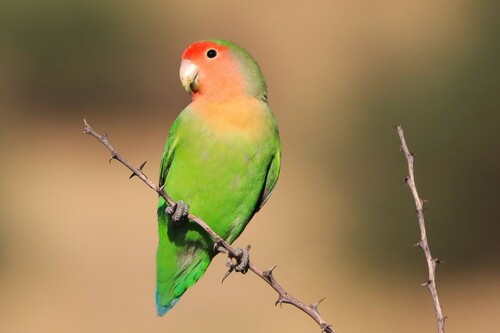
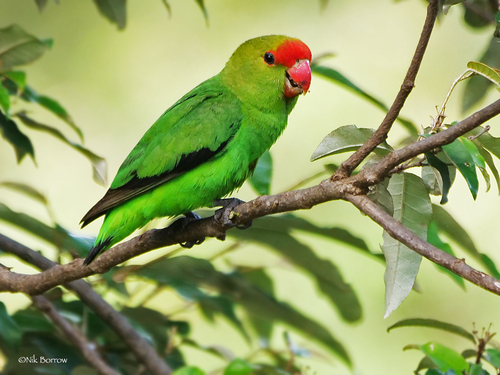
This species is commonly called black-winged lovebird, with the scientific name Agapornis taranta (Stanley, 1814). It is also known as Abyssinian lovebird. It measures around 16 to 16.5 cm (6.3 to 6.5 inches) in length, and is the largest lovebird species. Like the red-headed lovebird and grey-headed lovebird, the black-winged lovebird is sexually dimorphic. This dimorphism becomes visible in juvenile birds after their first molt, which occurs when they are around eight to nine months old. Both adult male and female black-winged lovebirds are mostly covered in green plumage. Only adult males have a red forehead and a ring of red feathers surrounding their eyes. The tail feathers are tipped with black, and the feathers below the tail are yellowish. The rump and feathers above the tail are light green. Males typically have black feathers under their wings, while females typically have greenish or brownish black underwing feathers. Both sexes have a red beak and gray feet. The natural range of the black-winged lovebird extends from southern Eritrea to southwestern Ethiopia, where individuals usually inhabit high plains or mountainous regions. Typical items in an Abyssinian lovebird's diet include sunflower seeds, corn, apples, and mission figs.