About Agapornis roseicollis (Vieillot, 1818)
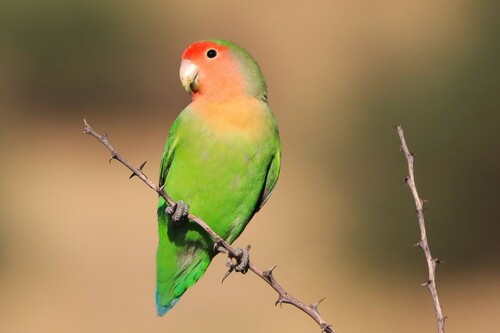
The rosy-faced lovebird (Agapornis roseicollis) is a small bird, measuring 17–18 cm (6.7–7.1 in) in total length, with an average wing length of 106 mm (4.2 in) and a tail length of 44–52 mm (1.7–2.0 in). Wild individuals are primarily green, with a blue rump. Their face and throat are pink, with the darkest pink colouration found on the forehead and above the eye. Their bill is horn-coloured, their iris is brown, and their legs and feet are grey. The pink colouring of the subspecies A. r. roseicollis is lighter than that of A. r. catumbella. Juvenile rosy-faced lovebirds have a pale pink face and throat, a greenish fore crown and crown, and a beak with a brownish base. This species naturally inhabits dry, open areas in southwest Africa. Its native range stretches from southwest Angola across most of Namibia to the lower Orange River valley in northwest South Africa. It can be found at elevations up to 1,600 metres (5,200 ft) above sea level, living in broad-leaved woodland, semi-desert, and mountainous areas. The species relies on access to water sources, and gathers around pools to drink. Escape from captivity is common in many regions around the world, so feral populations of rosy-faced lovebirds have established outside the native range. Feral populations live in metropolitan Phoenix, Arizona, where they occupy a range of both urban and rural habitats. Some feral birds live in cacti, and others regularly visit bird feeders in fairly large flocks. Since temperatures in Arizona regularly exceed 40 °C (104 °F), feral rosy-faced lovebirds have been observed gathering in large numbers on air-conditioner vents to keep cool. Feral colonies of this species can also be found on Maui and the Big Island in Hawaii. While individual rosy-faced lovebirds have been observed in the wild in Puerto Rico, these are almost certainly escaped pet birds, and no breeding population has been recorded there.