About Agama atra Daudin, 1802
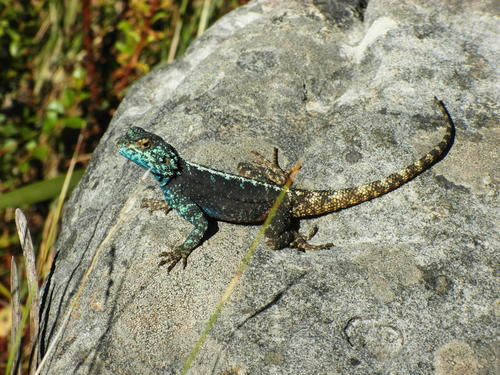
This rather sociable agama species, Agama atra Daudin, 1802, is normally found in small groups or colonies. It grows up to around 25 cm in length, with a thin dorsal crest that runs the full length of its body. It typically has a short, plump body, a thin tail, and a triangular head. During the breeding season, the heads of mature males turn bright blue. Males also frequently sit on top of prominent rocks, making them a common sight in mountainous regions of South Africa. Females and juvenile Agama atra are a more uniform greyish-brown and are much shyer than breeding males. These are active, diurnal lizards that normally hunt small insects including ants and termites. They sometimes adapt to living near urban areas and can even survive in rocky gardens. However, growing dense populations of pet domestic cats in suburban areas have caused a decline in this species' population, as these introduced predators kill all agamas in their immediate local areas. Natural wild predators of Agama atra include the fiscal shrike, various snakes, eagles, and larger reptiles. When under attack, agamas hide and only return once the danger has passed. Some Agama atra are kept as household pets, and generally have good relationships with their owners. This species has a limited ability to change body colour, though it cannot change colour to the same extent as chameleons; Agamidae, the family this species belongs to, is a sister group to chameleons. When a breeding-coloured male is approached by a potential predator, it will lie flat against a rock and abandon its bright breeding colours in favour of more cryptic, camouflaged colouration. A dominant male usually occupies a high elevation point in its territory, and performs a pushup display and head nodding to warn off intruding individuals. The natural distribution of Agama atra covers most of South Africa and Botswana, only excluding the sandy areas of South Africa's Northern Cape province, and parts of South Africa's Limpopo, Mpumalanga, and KwaZulu-Natal provinces.