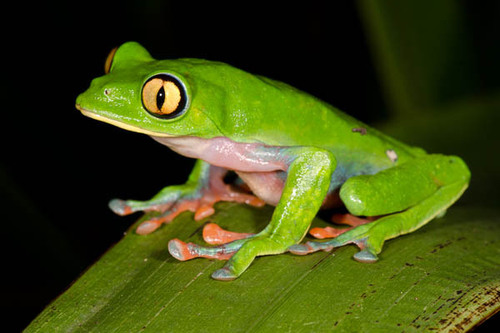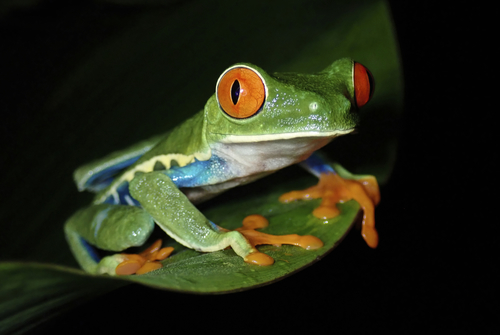
About Agalychnis callidryas (Cope, 1862)
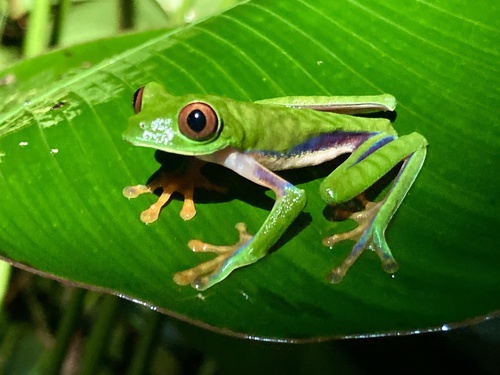
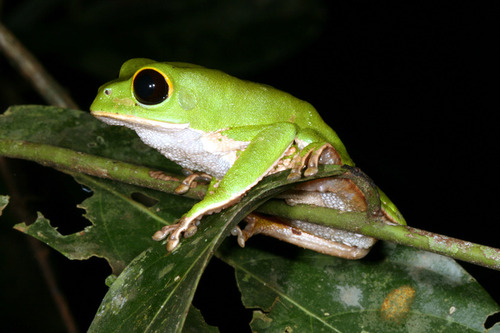
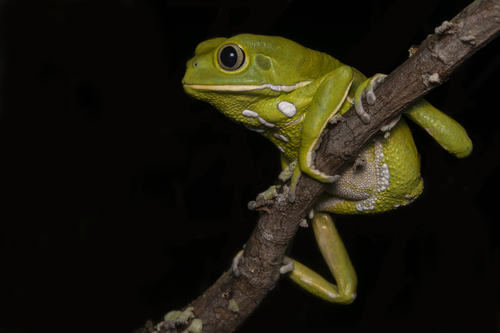
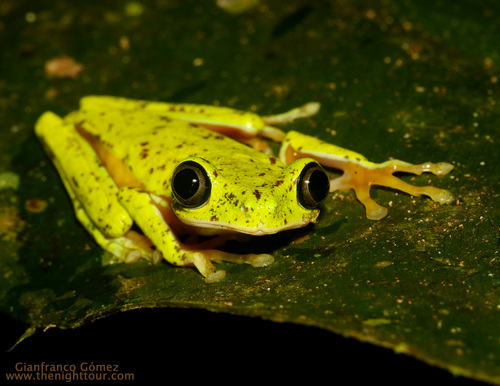
Agalychnis callidryas is easily recognizable by its colorful appearance. Males reach about 2 inches in length, while females grow to 3 inches, making females the larger of the two sexes. Adult individuals have distinctive coloration: bright green bodies, light blue or cream-colored bellies, and blue and yellow stripes along their sides. Their feet are bright orange and have suction cups that help them adhere to the undersides of leaves, where they spend most of their time. Their skin is smooth with little to no bumps, a feature that helps the frog blend into its leafy surroundings. A gland on the outermost layer of its skin secretes mucus to resist water loss and provide some defense against infections. One of its most striking features is its bright red eyes with vertical slits. This species does not have a true eyelid; instead, it has a nictitating membrane that allows light to enter the eye, so the frog will awaken when predators approach. The frog's coloration is an example of flash coloration, a pattern where an organism displays different colors at rest versus when in motion. For red-eyed tree frogs, the startling red eyes are hidden when the eyes are closed, letting the frog blend in with surrounding leaves. When the frog is startled, it can flash its bright red eyes, orange webbed feet, and blue and yellow lateral stripes. This display startles predators, giving the frog time to escape. Despite its bright coloration, this coloration does not indicate toxicity or aposematism, unlike the coloration of some related tree frog species. While the main body coloration of Agalychnis callidryas is consistent across the species, there are color morph variations across its geographical range. Variation occurs specifically in the color of the side stripes: in Costa Rica and Panama, these stripes can be blue, blue-red, orange, or purple. The species' green base color helps it blend easily into the vegetation of tropical rainforests. There are multiple hypotheses for why these color morphs exist. One well-supported hypothesis states that orange and purple morphs in Costa Rica exist due to isolation by distance, as these morphs are not genetically distinct groups. It is also possible that different selective pressures have shaped color patterns, and that some morphs exist due to genetic drift. Agalychnis callidryas is native to Central America, ranging from northeastern Honduras to northern Colombia. Its natural habitats include inland tropical and mountainous forests and wetlands, where there is forest cover and water nearby. Ponds or other bodies of water are essential for its reproduction, so the species is always found near these areas. It is commonly found in the tropical rainforests of the listed countries. The species is primarily arboreal, and prefers hiding in canopy cover among leaves. It requires high humidity levels of at least 80%. Red-eyed tree frogs mate seasonally, during the rainy season from October to March. Males attract females by croaking, and wrestle with each other in male-male competition to gain access to females for reproduction. Females cling to the underside of a leaf using the suction cup-like structures on their webbed feet, and must hold on while nearby males compete and wrestle. After a male wins the competition, the pair engages in amplexus, where the male grasps the female by the waist from behind. The female lays eggs on the underside of the leaf as the male fertilizes them. If undisturbed, eggs typically hatch within 6 to 7 days. This oviposition happens above or very close to a body of water, because newly hatched tadpoles drop from the leaf into the water below. Eggs can hatch early if their survival is threatened, a trait called phenotypic plasticity. The female chooses a leaf above a pond or large puddle to lay her clutch of roughly 40 eggs. Since oviposition can occur on either side of a leaf, red-eyed tree frogs may fold the leaf to hide eggs from predators. They also produce sticky jelly to glue the eggs together, which may protect eggs from splitting and dehydration. After fertilization, females lay clutches of about 40 eggs, and can lay multiple clutches in a single night. Because eggs are adhered to a leaf above water, tadpoles fall into the water below immediately after hatching. Eggs usually hatch 6–8 days after being laid, with some variation based on geography and risk detection through vibration. Depending on environmental conditions, tadpoles stay in the water for a few weeks to several months. After metamorphosis, they develop the adult color pattern, and live for about five years in the wild. Red-eyed tree frog embryos use natural day and night light cycles as a hatching signal, and most often hatch just after nightfall. Dragonflies, fish, and water beetles prey on tadpoles. Tadpoles remain in the water from three weeks to several months, until they metamorphose into adult frogs. The timing of metamorphosis depends on the length of the larval stage, which varies based on environment. After metamorphosis, the torso color of tadpoles changes from green to brown, and their initially yellow eyes turn deep red, with little side patterning developing. These changes mark sexual maturity. The overall lifespan of red-eyed tree frogs is about five years.