About Afrotis afraoides (A.Smith, 1831)
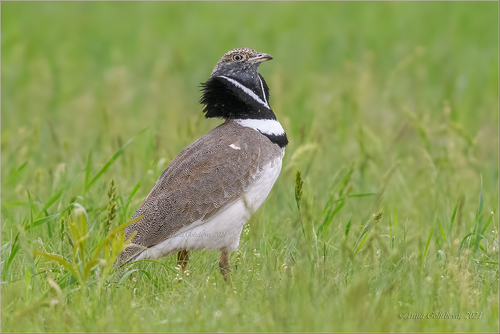
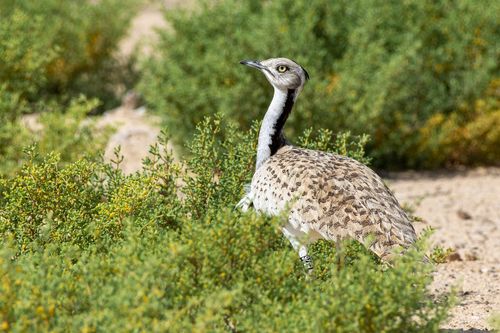
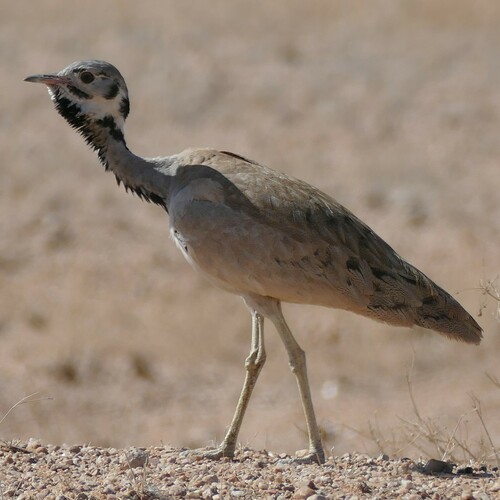
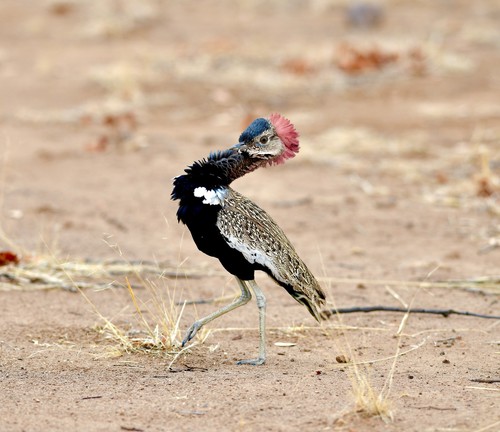
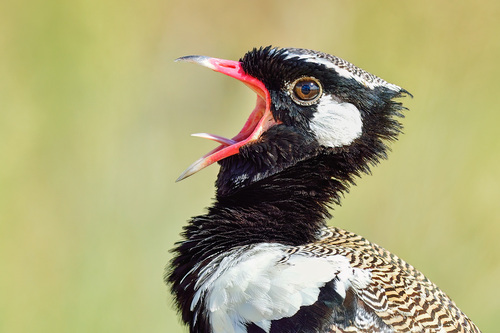
The male Afrotis afraoides has regularly patterned black and white barring on the back and wings, with black plumage on the head, neck, and underparts. The female has black and buff barring or chequer patterning on the head, neck, breast, and upper parts, and a black belly. This species can be distinguished from the southern black korhaan by its largely white primary feathers, which are black in the southern black korhaan. Both males and females have red beaks and bright yellow legs.
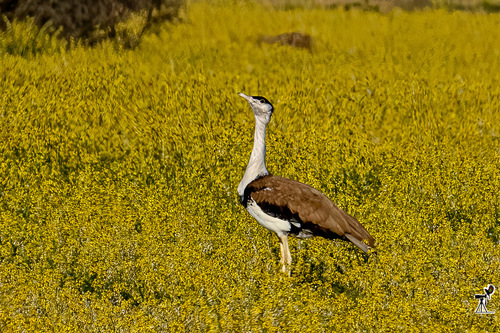
Afrotis afraoides, commonly called the northern black korhaan, is distributed across Namibia, Botswana, Lesotho, and northern South Africa. It inhabits grassland with vegetation up to one metre high, grassy dunes, semi-arid scrubland, and open veldt.
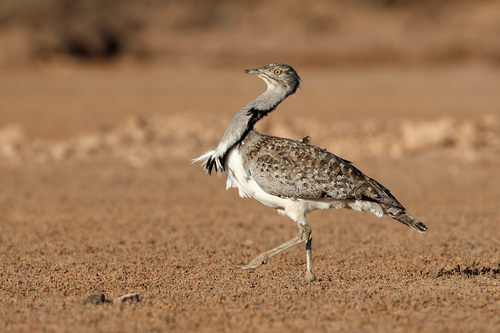
The northern black korhaan is a primarily ground-dwelling bird. It will sometimes take flight when disturbed, and males produce a loud, raucous "kraark, kraark" call. When approached by an intruder, a male often runs away with its head and neck extended, then freezes, becoming surprisingly hard to spot. Females are less conspicuous and are rarely seen. These birds forage as they walk, feeding on and chasing insects including termites, ants, grasshoppers, and beetles, as well as spiders, ticks, and seeds.
Breeding can occur at any time of the year. Males perform a courtship display that includes dipping flights, flaring white feathers, and ritual chasing of other birds. A male will display to multiple females, defends a territory, and chases away other males. The nest is a scrape on the ground that holds one or two eggs.