About Afrixalus delicatus Pickersgill, 1984
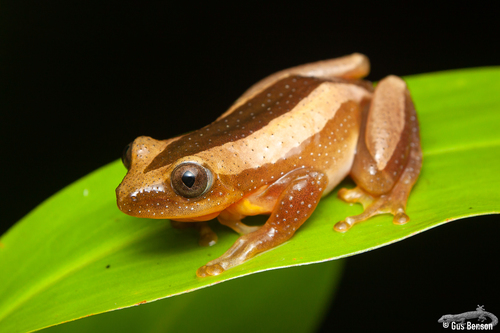
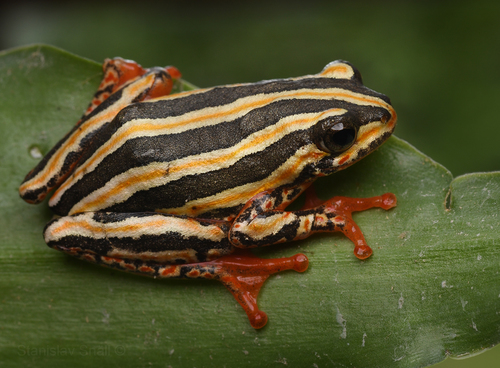
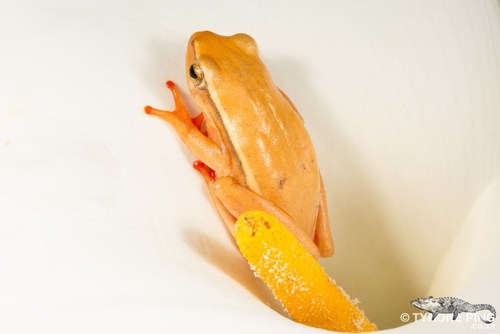
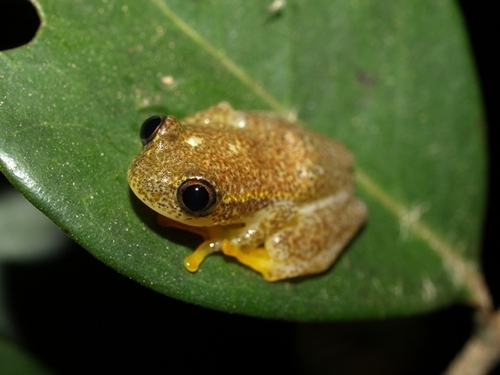
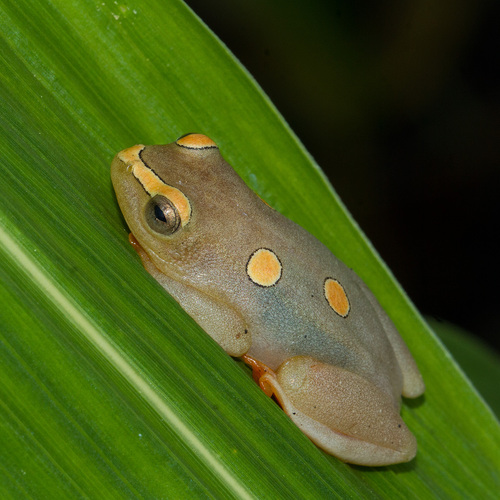
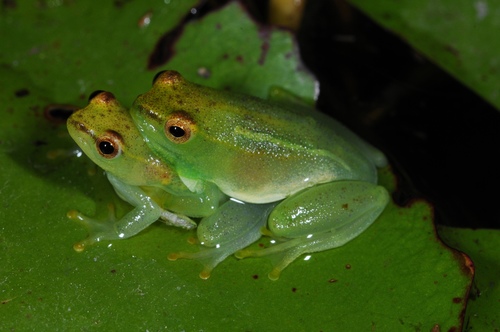
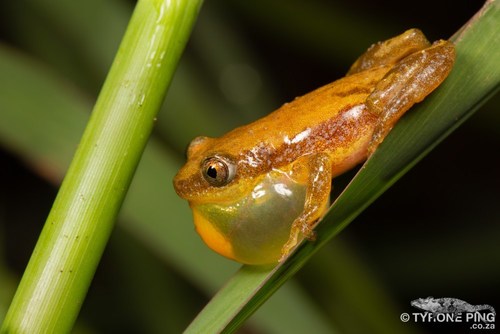
Description: Adult males of Afrixalus delicatus measure 15–20 mm (0.59–0.79 in) in snout–vent length, while adult females measure 17–22 mm (0.67–0.87 in). The dorsum ranges from light brown to gold with a brassy sheen. Vague brown speckles cover the mid-dorsum, and there is a lateral line that is well-defined in its anterior section. Both the speckles and lateral line vary in colour from reddish brown to nearly black, and this variation is likely dependent on temperature, light and humidity. The tibia is yellow with an oblique transverse stripe. The venter is white, the gular disc is orange-yellow, and the hidden areas of the limbs are yellowish. Tiny asperities cover most parts of the body. Males produce two types of advertisement calls: the first is a high-pitched rattle made up of multiple distinct, separate clicks, and the second is an intense, high-pitched buzz-like "zick" that rises in pitch. The second call type appears to be the mating call. Habitat and conservation: Afrixalus delicatus lives in coastal bushland, savanna, shrubland, grassland, forest, thicket, and modified habitats, at elevations up to 500 m (1,600 ft) above sea level. Breeding occurs in emergent vegetation, usually at the edges of relatively permanent water bodies. This species prefers plants with long leaves that can be folded to create leaf nests over water. During the day, individuals may hide in the leaf axils of arum lilies belonging to the genus Zantedeschia. Afrixalus delicatus is common in the northern part of its range, where very large breeding aggregations occur. It is uncommon and has declined in the extreme south of its range, though it may have been overlooked there. In the southern part of its range, it is threatened by the drying of breeding sites caused by sugar cane farming, urbanization, and the spread of eucalyptus. Chemical mosquito control may also pose a threat to some populations. This species is found within many protected areas.