About Aetomylaeus bovinus (Geoffroy Saint-Hilaire, 1817)
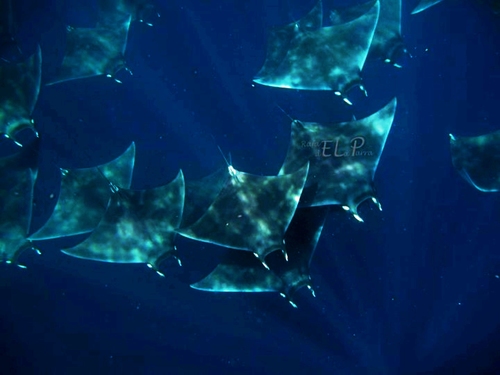
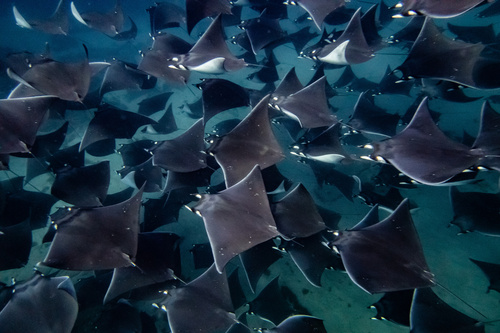
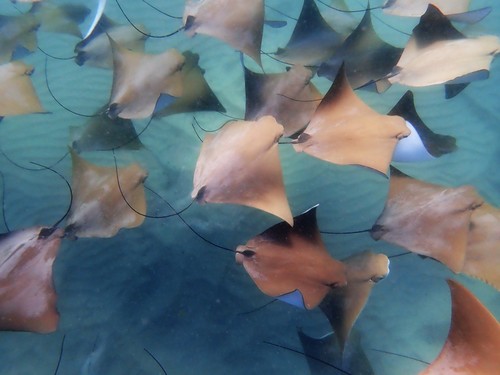
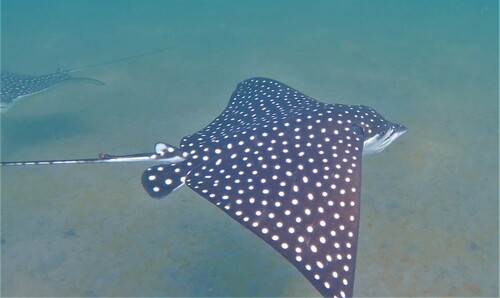
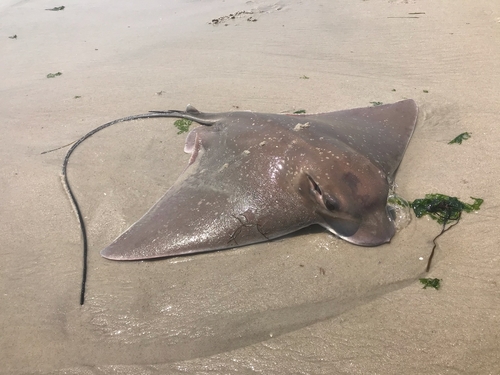
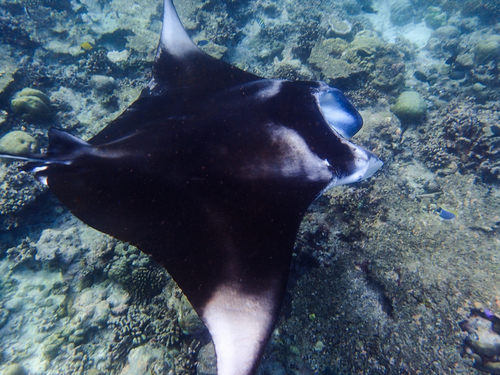
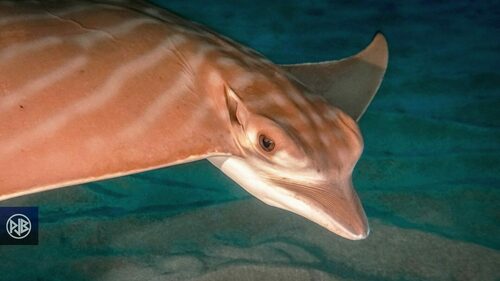
Aetomylaeus bovinus (first described by Geoffroy Saint-Hilaire in 1817) is commonly called the bull ray, duckbill ray, or duckbill eagle ray. It is a large stingray species belonging to the family Myliobatidae, found along the coasts of Europe and Africa. Its full total distribution remains uncertain. Confirmed locations of occurrence include the Mediterranean Sea, the Black Sea, the eastern Atlantic Ocean between Portugal and Guinea, the Atlantic waters north of Saldanha Bay in western South Africa, the entire remaining South African coast extending into the Indian Ocean up to Maputo Bay in southern Mozambique, and the coastal waters off Zanzibar and Kenya. This species occurs from the surf zone down to depths of 65 meters (213 feet) or deeper, and it will enter estuaries and lagoons. Some of its shallow coastal habitats, such as those around Malta, may act as nursery areas for the species. It can be found both near the seabed and at the water surface, and sometimes leaps out of the water. Many details about the species' ecology and distribution are still unknown, including its total population size, population trends, and movement dynamics. Like most members of Myliobatidae, Aetomylaeus bovinus is a migratory species. Tagged specimens off the coast of South Africa have been recorded making migrations longer than 900 kilometers, and the species displays seasonal philopatry. A. bovinus is ovoviviparous, and individuals reach sexual maturity between four and six years of age. The species has low fecundity, producing only three to four pups per litter, and a long gestation period that ranges from six to 12 months depending on geographic location. This life history strategy makes the species very sensitive to disturbance. Very little is currently known about the overall ecology and behavior of this species. It is classified as coastal marine megafauna, and qualifies as a shallow-water giant: it reaches a maximum disc width (from tip to tip) of 2.22 meters (7 feet 3 inches), a total maximum length of 1.5 meters (4 feet 11 inches), and a maximum weight of 116 kilograms (256 pounds). As with many elasmobranch species, female A. bovinus are larger and heavier than males. This species exhibits some schooling behavior, the details of which are not yet understood. The species' large maximum size and general preference for shallow depths between 0 and 30 meters (0 to 98 feet) leaves it exposed to a variety of threats. Bull rays are extremely rare throughout the Mediterranean region, and the species' overall population is currently decreasing. It is estimated that the population has declined by more than 80% over the last three generations. The common name "bull ray" comes from the shape of the species' head, while the alternative name "duckbill ray" (used most often in South Africa) refers to its long, flat, round snout. Bull rays are bentho-pelagic feeders, meaning they feed both on the seafloor and in the open water column. They consume a variety of invertebrates, including crabs, hermit crabs, squids, prawns, gastropod molluscs, and bivalve molluscs. Their feeding often causes damage to commercial clam and oyster farms. The dorsal patterns of bull rays do not change as individuals age, so they are consistent across the lifespan, which allows researchers to use photo identification methods to identify individual bull rays. Similar photo identification methods are already well documented and widely used for other elasmobranch species that have unique individual markings, such as whale sharks and manta rays.