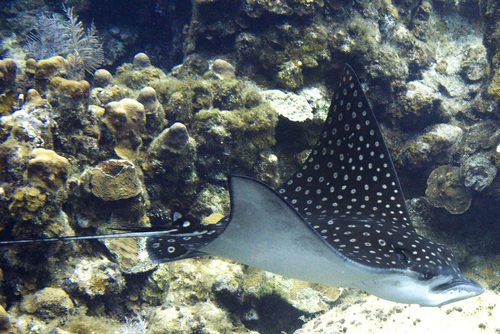
About Aetobatus ocellatus (Kuhl, 1823)
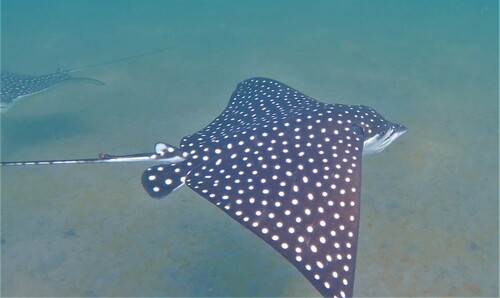
Description and behavior: When compared to the spotted eagle ray Aetobatus narinari, Aetobatus ocellatus has a longer tail, with an average total length of 281% of disc width versus 263% DW in the spotted eagle ray, and a longer stinging spine, with an average length of 9.7% of DW versus 8.9% DW in the spotted eagle ray. The dorsal surface background color of A. ocellatus ranges from dark greenish or greyish to almost black, while A. narinari has a much paler coloration, ranging from medium yellowish to brownish. A. ocellatus foraging range is shaped by anthropogenic noise, and the species' populations are structured by ontogenetic stage. Reproduction: The ocellated eagle ray is ovoviviparous. Its embryos feed on yolk initially, then gain additional nutrients from the mother through indirect absorption of nutrient-enriched uterine fluid. The gestation period lasts more than 12 months, and females produce only a small number of pups per gestation.