About Aetobatus narinari (Euphrasen, 1790)
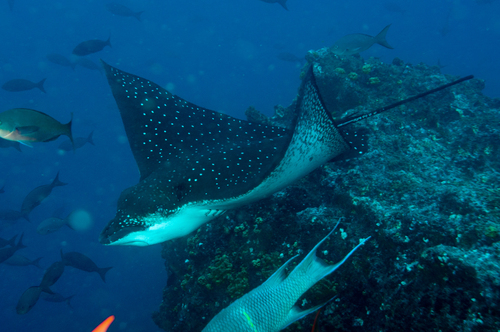
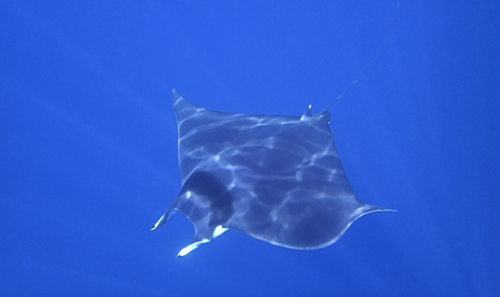
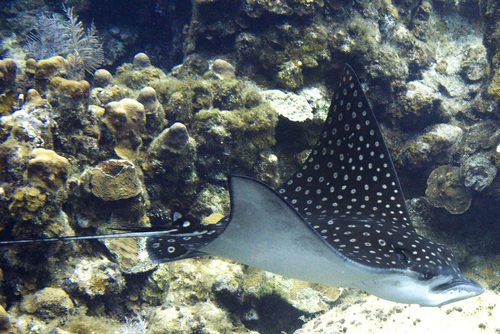
The spotted eagle ray, with the scientific name Aetobatus narinari, is a cartilaginous fish belonging to the eagle ray family Aetobatidae. Traditionally, this species was recognized as occurring globally across all tropical regions, including the Atlantic, Pacific, and Indian Oceans. Recent taxonomic authorities have restricted the range of Aetobatus narinari to only the Atlantic Ocean, which includes the Caribbean and Gulf of Mexico. Populations outside the Atlantic are now classified as separate species: the ocellated eagle ray A. ocellatus and the Pacific white-spotted eagle ray A. laticeps. Spotted eagle rays are most often observed alone, but they will occasionally swim in groups. This species is ovoviviparous, meaning females retain eggs internally and release fully developed young that resemble miniature versions of adult spotted eagle rays. The species can be identified by its dark dorsal surface covered in white spots or rings. Just behind the pelvic fins near the base of its relatively long tail, it has several venomous, barbed stingers. Spotted eagle rays typically feed on small fish and crustaceans, and they sometimes use their snouts to dig for food buried in the seabed’s sand. These rays are commonly seen leaping out of the water; there have been at least two reported incidents of them jumping into boats, one of which caused the death of a woman in the Florida Keys. A wide variety of shark species hunt spotted eagle rays. The spotted eagle ray is classified as Near Threatened on the IUCN Red List. It is fished mainly in Southeast Asia and Africa, and is most commonly traded commercially for display in aquariums. It receives protected status in the Great Barrier Reef. As traditionally defined, spotted eagle rays live in tropical regions globally across the Indo-Pacific (including the western Pacific Ocean and Indian Ocean) and the western Atlantic Ocean. They inhabit shallow coastal waters near coral reefs and bays, at depths down to 80 meters (262 ft), and can also be found in warm and temperate waters worldwide. In the western Atlantic Ocean, the species occurs off the eastern coast of the United States, throughout the Gulf Stream and the Caribbean, and extends south past southern Brazil. In the Indian Ocean, it ranges from the Red Sea south to South Africa and east to the Andaman Sea. In the Western Pacific Ocean, it is found near Japan and north of Australia. In the Central Pacific Ocean, it occurs throughout the Hawaiian Islands. In the Eastern Pacific Ocean, it ranges from the Gulf of California south to Puerto Pizarro, including the Galapagos Islands. Spotted eagle rays are most commonly found in bays and reefs. They spend most of their time swimming freely in open waters, generally in schools near the surface, and can travel long distances within a single day. Across this traditional range, populations show significant genetic and morphological variation. As a result, recent authorities have split the traditional species into three separate species: true A. narinari is restricted to the Atlantic, while Indo-Pacific populations belong to A. ocellatus and East Pacific populations belong to A. laticeps. For reproduction, one or occasionally multiple males will pursue a female. When a male approaches a female, he uses his upper jaw to grab her dorsum. He then rolls the female over by grabbing one of her pectoral fins, which are positioned on either side of her body. Once he is positioned on her ventral side, the male inserts a clasper into the female, joining them belly-to-belly. The entire mating process lasts between 30 and 90 seconds. Spotted eagle rays develop ovoviviparously: eggs are retained inside the female and hatch internally, with embryos feeding off a yolk sac until live birth. After a one-year gestation period, a mother gives birth to a maximum of four pups. At birth, the disc of a pup measures 17–35 centimeters (6.7–13.8 in) across. Young rays reach sexual maturity between 4 and 6 years of age. Genetic evidence confirms that spotted eagle rays are capable of consecutive parthenogenesis.