About Aethina tumida Murray, 1867
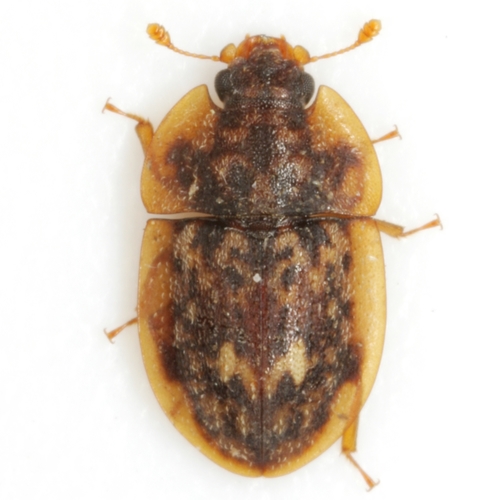
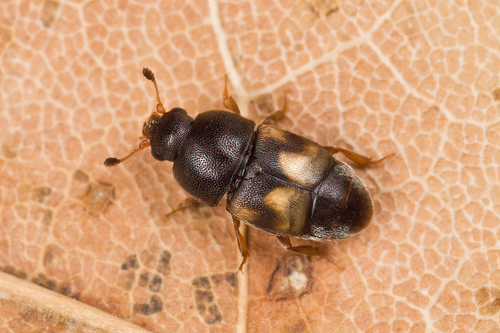
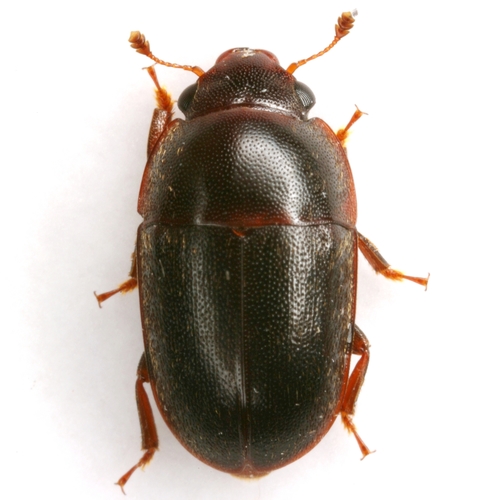
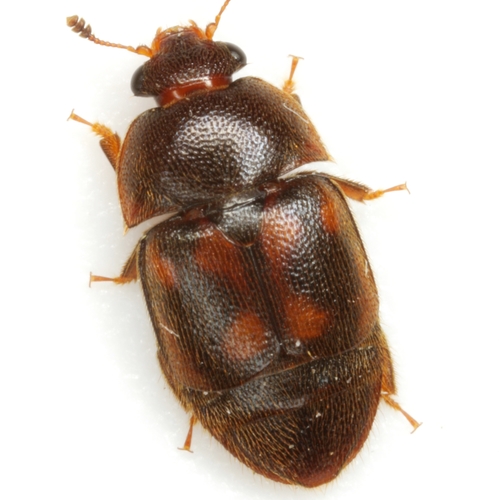
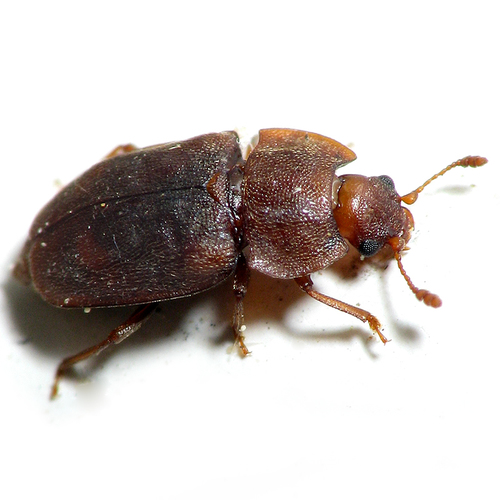
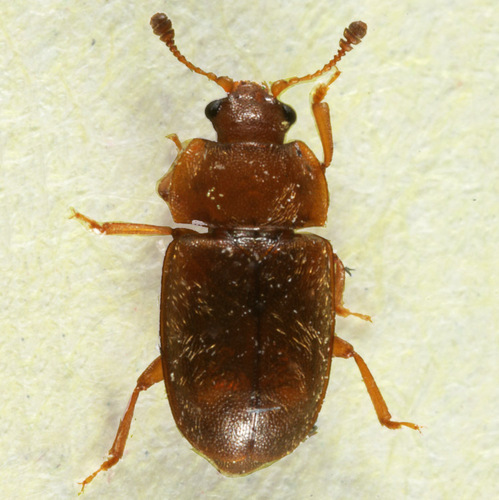
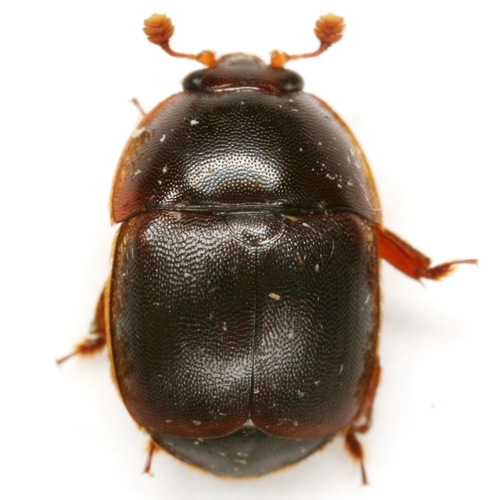
Aethina tumida Murray, 1867, commonly called the small hive beetle, is a small insect, measuring around 5–7 mm in length and 2.5–3.5 mm in width. This species exhibits sexual dimorphism, as females are typically longer and heavier than males. Beetle size can vary based on environmental factors including diet, temperature, and humidity. Structurally, small hive beetles have three pairs of walking legs, two antennae, two pairs of wings, and a bilaterally symmetrical body. Their body color ranges broadly from orange-brown to dark brown or black. As an ectothermic species, small hive beetles rely on external heat sources to regulate their body temperature. Immature small hive beetles have a very distinct appearance compared to adults. The species' eggs are elongated and white. Larvae are pale whitish, have a segmented body, and have three pairs of legs positioned behind the head. As their exoskeleton develops, pupae turn brown, taking on an appearance much more similar to adult beetles. The small hive beetle was first discovered in the United States in 1996, and has now spread to 27 U.S. states, including Hawaii. A small hive beetle infestation occurred in British Columbia in 2015, which prompted a temporary quarantine. In Mexico, the species has become established in at least eight states, with particularly high infestation levels in tropical areas such as the Yucatán. It was first detected in Belize's Corozal District in 2016, and was reported in Honduras in 2024. The small hive beetle has also spread to Australia, where it is found in Richmond (New South Wales), Queensland, and most of New South Wales. It has not been found in the Northern Territory, and is no longer a notifiable pest in Victoria and South Australia. In Western Australia, it is restricted to the Kimberley region. It has been hypothesized that the species invaded Australia via import of package bees, honeybee or bumblebee colonies, queens, hive equipment, or even soil, but current evidence does not confirm how small hive beetles actually reached the country. The small hive beetle has now reached southern Mindanao in the Philippines, and may spread across the country if hives and bees are moved to other areas. It was first detected in Calabria, southern Italy, in September 2014. It is currently confined to the provinces of Reggio Calabria and part of Vibo Valentia, where it has become naturalized. Infestation outbreaks occurred in eastern Sicily in 2014 and 2019. Female small hive beetles lay eggs within bee brood, where larvae hatch after. Pupation takes place under soil. Adults primarily live inside host hives and seek food from their hosts. In colder climates, adults overwinter alongside bee populations. Adult small hive beetles have strong flying ability, capable of traveling up to 16 kilometers. Adults that have just emerged from pupation do not typically invade honeybee hives near their pupation location, and instead prefer to make long-distance flights. The peak of the species' reproduction period varies by location. Most small hive beetle populations reach their highest density during summer and early autumn, when temperatures are high. Some populations reach peak density in the rainy season, while others peak in the dry season. Small hive beetles are omnivorous, feeding on both animal and plant resources. Animal-based foods include bee eggs, host body fluids, and dead bees. Plant-based foods include fruit, nectar, and pollen. Both adults and larvae feed on the same types of food.