About Aesculus hippocastanum L.
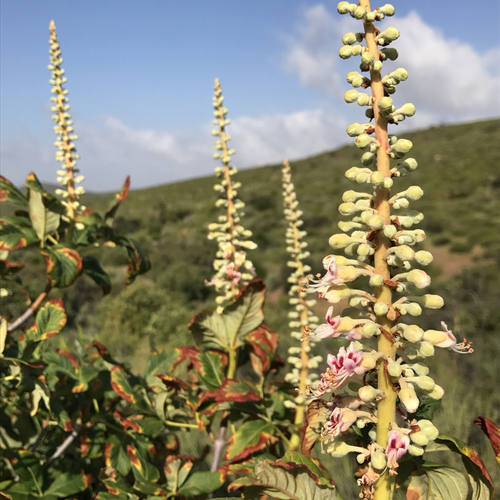
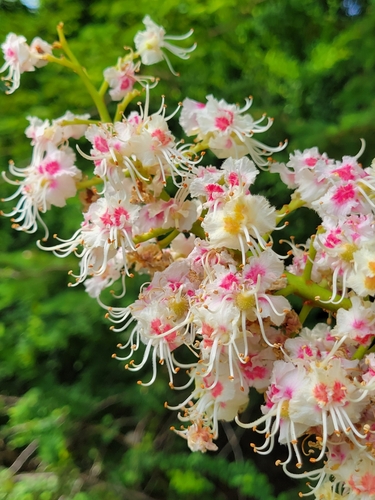
Aesculus hippocastanum L., commonly known as horse chestnut, is a large tree that grows to around 39 metres (128 ft) tall, with a domed crown of stout branches. On mature old trees, the outer branches are often pendulous, with curled-up tips. Its leaves are opposite and palmately compound, with 5 to 7 leaflets measuring 13–30 cm (5–12 in) long. This makes the full leaf up to 60 cm (24 in) across, attached to a 7–20 cm (3–8 in) petiole. After leaves fall from twigs, the remaining leaf scars have a distinctive horseshoe shape, complete with seven visible "nails". The tree's flowers are usually white, with a yellow to pink blotch at the base of the petals. Flowers emerge in spring in erect panicles 10–30 cm (4–12 in) tall, with roughly 20 to 50 flowers per panicle. This tree's pollen is not poisonous to honey bees. Typically, only 1 to 5 fruits develop on each panicle. The fruit is a green, spiky capsule that holds one nut-like seed called a conker or horse-chestnut; two or three seeds are rare. Each conker is 2–4 cm (3⁄4–1+1⁄2 in) in diameter, glossy nut-brown, and has a whitish scar at its base. Different sources report different native distributions for Aesculus hippocastanum. As of March 2023, Plants of the World Online lists the species as native to the Balkans (Albania, Bulgaria, Greece, and former Yugoslavia), as well as Turkey and Turkmenistan. A 2017 IUCN Red List assessment restricted its native range only to the Balkan area: Albania, Bulgaria, mainland Greece, and North Macedonia. This species has been introduced and planted across the globe. It grows in many parts of Europe, reaching as far north as Harstad (north of the Arctic Circle in Norway) and Gästrikland in Sweden. It is also commonly found in many parks and cities across the northern United States and Canada, including Edmonton, Alberta. The compact native horse chestnut population in Bulgaria is distinct from the horse chestnut forests of northern Greece, western North Macedonia, and Albania. It is restricted to a 9 ha (22 acre) area in the Preslav Mountain, north of the Balkan Mountains, in the valleys of the Dervishka and Lazarska rivers. Bulgaria's relict horse chestnut forests are classified as critically endangered at the national level, and are protected as part of the Dervisha Managed Nature Reserve. There is a documented risk of acute kidney injury associated with this plant: when patients who had undergone cardiac surgery were given high intravenous doses of horse chestnut extract to treat postoperative oedema, harm was dose-dependent. No changes to kidney function were recorded at a dose of 340 μg/kg, mild kidney function impairment developed at 360 μg/kg, and acute kidney injury occurred at 510 μg/kg. Raw horse chestnut seed, leaf, bark, and flower are toxic due to the presence of aesculin, and should not be eaten. The U.S. Food and Drug Administration classifies horse chestnut seed as an unsafe herb, and its glycoside and saponin constituents are considered toxic. Aesculus hippocastanum is widely cultivated in streets and parks across the temperate world, and has grown particularly well in places such as Ireland, Great Britain, and New Zealand, where it is common in parks, streets, and avenues. It is cultivated for its spectacular spring blooms, and grows successfully across a wide range of temperate climates as long as summers are not excessively hot. Cultivated trees are grown as far north as Edmonton, Alberta, Canada, the Faroe Islands, Reykjavík, Iceland, and Harstad, Norway. In Britain and Ireland, the seeds are used for the popular children's game conkers. During the First World War, the government ran a campaign asking everyone, including children, to collect and donate conker seeds. The conkers were used as a starch source for fermentation via the Clostridium acetobutylicum method developed by Chaim Weizmann, to produce acetone used as a solvent for cordite, a component of military armaments. While Weizmann's process could use any starch source, the government chose conkers to avoid depleting food supplies that would cause starvation. Conkers were ultimately found to be a poor starch source, and the factory only produced acetone for three months. Regardless, conkers were collected again during the Second World War for the same purpose. Young, fresh seeds are slightly poisonous, containing alkaloid saponins and glucosides. They are not dangerous to touch, but cause sickness if eaten. If consumed by horses, they can cause tremors and loss of coordination. This species is a popular subject for bonsai cultivation. Although conker seeds are claimed to repel spiders, there is little evidence to support this claim. The presence of saponin may repel insects, but it is unclear if this effect works on spiders. Aesculus hippocastanum is commonly damaged by the leaf-mining moth Cameraria ohridella, whose larvae feed on horse chestnut leaves. The moth was first described from specimens collected in North Macedonia, where the species was discovered in 1984, and took 18 years to spread to Britain. In Germany, particularly in Bavaria, horse chestnuts are commonly planted in beer gardens. Before mechanical refrigeration was invented, brewers dug cellars for lagering beer. To further protect these cellars from summer heat, brewers planted horse chestnut trees, which have wide, dense canopies but shallow roots that do not intrude into the underground cellars. The practice of serving beer at these sites eventually developed into the modern beer garden. An inexpensive, environmentally friendly detergent for washing clothes can be made at home using conkers. In traditional medicine, horse chestnut seed extract standardized to around 20 percent aescin (also called escin) is used for its reported effect on venous tone. A 2012 Cochrane Review of low-quality studies suggested that horse chestnut seed extract may be an efficacious and safe short-term treatment for chronic venous insufficiency, but definitive randomized controlled trials have not been completed to confirm this efficacy.