About Aesculus flava Sol.
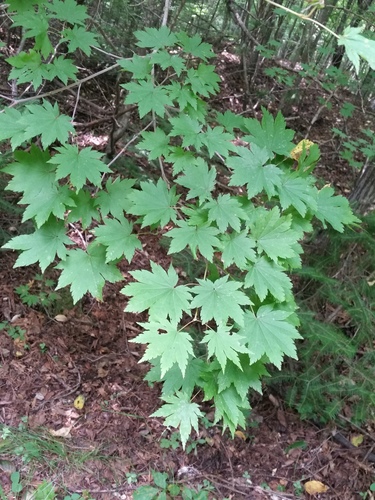
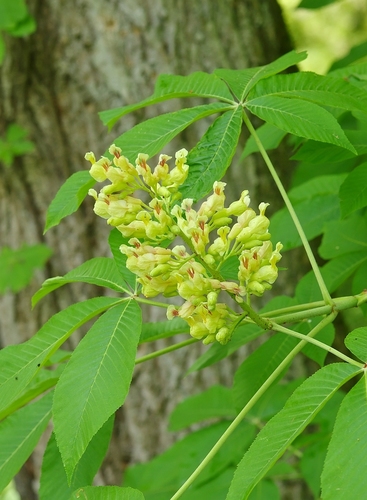
Aesculus flava Sol., commonly known as yellow buckeye or sweet buckeye, is a canopy tree with an irregular to upright-oval growth form. It typically reaches 50 to 75 feet in height, with stout picturesque branches that often sweep the ground. In mountain habitats it can grow up to 90 feet tall and over 40 feet wide, with a 3-foot diameter trunk, while it more often takes the form of a small tree or shrub in lowland areas. Its leaves are deciduous and palmately compound, usually with five (rarely seven) leaflets that measure 10 to 25 cm long and broad. These leaves typically turn orange to red in autumn. In spring, the tree produces yellow to yellow-green flowers arranged in panicles; each flower is 2 to 3 cm long, and has stamens shorter than its petals, a feature that distinguishes it from the related Ohio buckeye (Aesculus glabra), which has stamens longer than its petals. After flowering, the tree develops a smooth, spineless, round or oblong capsule fruit 5 to 7 cm in diameter. The capsule is a leathery light brown partitioned husk that holds 1 to 3 nut-like seeds, each 2.5 to 3.5 cm in diameter, brown with a whitish basal scar. The fruit's resemblance to a deer's eye gives the tree its common name buckeye. Its bark is dark gray to brown on young trunks, becomes furrowed and ridged in middle-aged trees, and develops a scaly, platy texture when mature. Twigs have a faintly rank odor, much milder than that of A. glabra. The wood is soft, weak, and does not resist decay; it has a bad odor when green, but seasoned wood is odorless, white, and lightweight. The fruit is poisonous to humans due to saponins, but can be made edible through a leaching process. Saponins from the seeds are poisonous; they are poorly absorbed by the human body and usually pass through without harm, but eating large portions may cause abdominal pain, and poisoning, while rare, is possible. Yellow buckeye grows best in full sun (6 or more hours of direct sunlight daily), though it tolerates partial shade. It thrives in moist, rich, well-drained, seepage-prone, slightly acidic soils, and does not grow well in poor clay or dry soils, but it can tolerate short periods of flooding and urban conditions. Its natural distribution extends from southwestern Pennsylvania to northern Alabama and Georgia, along the Ohio River valley into Illinois, where it grows in rich soils on river bottoms, stream banks, and mountain slopes. It has a low flammability rating. This tree is messy due to heavy leaf and flower litter in summer and fall, produces fruit litter that is undesirable in urban areas, and requires a large space such as a big park or yard to thrive, making it unsuitable for small sites. The fruit serves as food for wildlife, specifically squirrels, and flower nectar attracts hummingbirds, bees, butterflies, and other pollinating insects. Historically, Native Americans processed the seeds to make food: they leached out toxins by slow-roasting the nuts, cutting them into thin slices, placing the slices in a cloth bag, and rinsing them in a stream for 2 to 3 days. Raw seeds are bitter, but cooked processed seeds are reported to taste as sweet as chestnuts. A paste made from the seeds is used in bookbinding to deter insect damage. Saponins extracted from chopped seeds steeped in hot water can be used as a soap substitute for washing the body or clothes. It is the softest of all American hardwoods, so it makes poor lumber, but it is used for pulpwood and woodenware, including artificial limbs. Aesculus flava is cultivated as an ornamental tree. Its showy yellow flowers and attractive autumn color make it popular for large gardens and parks. It is identified as a pollinator plant that attracts hummingbirds and bees, and has received the Royal Horticultural Society's Award of Garden Merit.