About Aerva javanica (Burm.fil.) Juss.
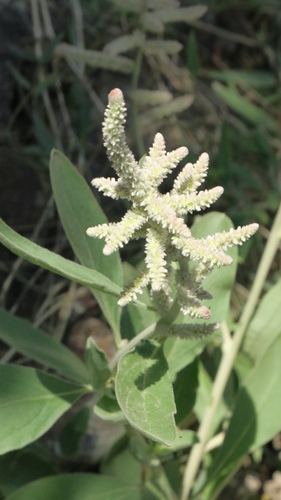
This species has the scientific name Aerva javanica (Burm.fil.) Juss., and is commonly known as Kapok Bush; it is called Bilhangga in the languages of the Yindjibarndi and Ngarluma people. Aerva javanica is a herbaceous, multi-stemmed, soft-wooded plant with broad leaves that often grows in an erect habit, reaching a height of around 1.6 metres (5 ft 3 in). In Western Australia, it usually grows in sandy soils, particularly along drainage lines, and it flowers between January and October. This species uses C4 carbon fixation, and it is dioecious, meaning separate individual plants produce male and female flowers. It reproduces through diplospory, a type of agamospermy that occurs during the development of the female gametophyte in the ovule. During this process, reduction division does not take place in the megaspore mother cell, and an unfertilized diploid egg develops into an embryo. This means daughter plants are exact genetic clones of the mother plant. Aerva javanica has deep roots, so it is used as a soil binder for desert reclamation. It is also used for fuel and as goat fodder. In traditional medicine, seeds are believed to cure headaches, and a gargle made from the plant is used to attempt to treat toothache. Thick, white inflorescences from this plant have traditionally been harvested in Arabia for stuffing cushions and saddle pads; today, the soft fibres are still used as kapok for pillows. The species has naturalized as an alien introduction in northern regions of Australia, and it is cultivated and utilized by indigenous peoples of some countries.