About Aeronautes saxatalis (Woodhouse, 1853)
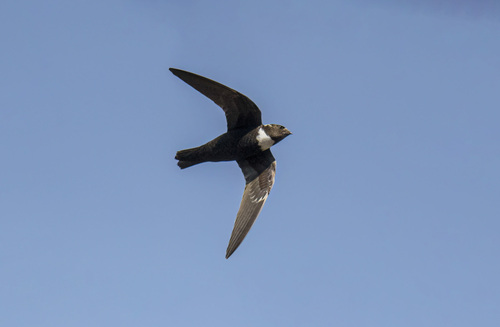
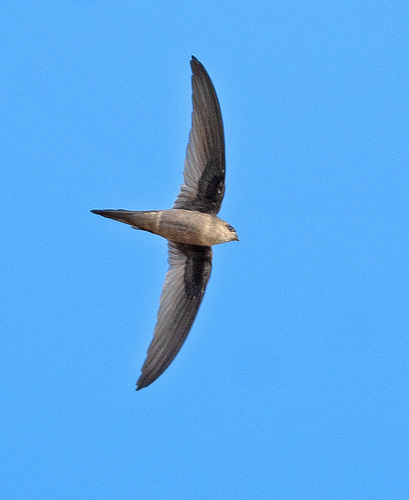
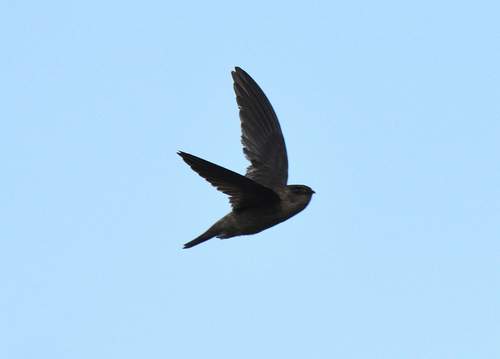
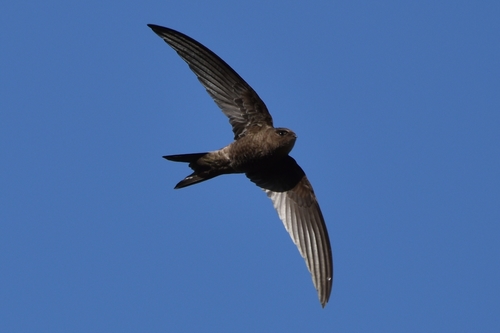
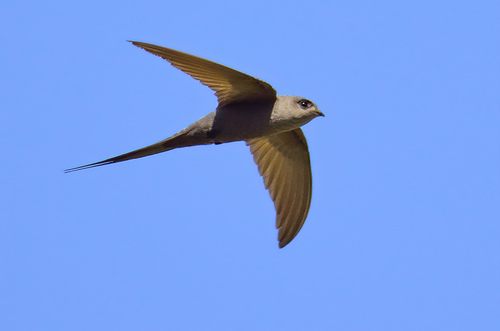
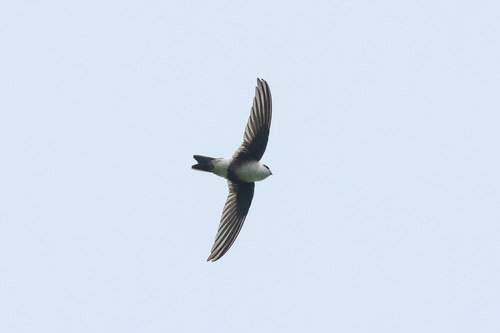
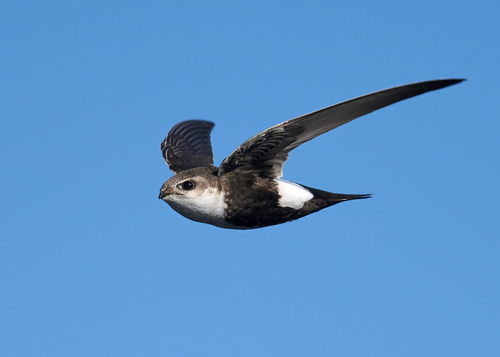
The white-throated swift, scientifically named Aeronautes saxatalis (Woodhouse, 1853), is a medium-sized bird with a primarily black and white plumage. Its back and wings are blackish-brown or black, while its breast, belly, chin, and throat are white. In newly molted adult individuals, the dark feathers can carry a faint greenish sheen, though this feature is very rarely visible in field observations. Males and females cannot be told apart by their plumage. Juvenile (first basic) plumage resembles adult (definitive basic) plumage, but the head and neck feathers of juveniles are duller and paler. Full-grown adults are typically 15 to 18 centimeters long, and have a tail with a relatively shallow notch that measures 10 millimeters deep. Adult white-throated swifts weigh between 28 and 36 grams, with a recorded average weight of 32.5 grams, and there is no size difference between males and females. The species has a wingspan of 35.5 centimeters. White-throated swifts can look similar to American black swifts and Vaux's swifts, both of which also live in western North America, but white-throated swifts can be identified by their white underparts, a feature neither of the other two species have. White-throated swifts are permanent year-round residents of coastal and southern California, southern Arizona, southern New Mexico, western Texas, central Mexico, and the Sierra Madre Occidental and Oriental mountain ranges. Migratory breeding populations occur from Arizona and New Mexico north to southern British Columbia, and from central California east to eastern Colorado and Wyoming. In the southern section of this migratory range, the birds arrive in mid-March and depart in mid-October. In the northern part of the range, the birds do not arrive until mid-April to early May, and depart between late August and mid-September. Non-breeding wintering populations are found in two main regions: the first includes southwestern California, eastern Arizona, and the Texas Panhandle, while the second is in El Salvador, Guatemala, Honduras, and the Mexican state of Chiapas. White-throated swifts roost on natural cliffs, bluffs, and canyons, as well as man-made structures such as bridges, overpasses, and quarry walls. In natural habitats, the swifts form colonies of up to 400 to 500 birds in protected cliff crevices that are typically 6 to 50 meters above ground. They sometimes roost and nest alongside colonies of other swallow species, including cliff swallows, violet-green swallows, and northern rough-winged swallows. While foraging, white-throated swifts fly over meadows, agricultural fields, and open areas along the edges of ridges and hills. During courtship season, white-throated swifts may perform gliding displays and plummeting courtship falls before forming monogamous pairs. Once a pair has formed, they build nests out of plant material and feathers bound together with saliva, placed on rocky cliff faces or human-made structures. These nests are usually 8 to 10 centimeters across, and 2.5 to 2.8 centimeters deep, and may be reused for multiple consecutive years. On average, 4 to 5 white matte eggs are laid over 4 to 6 days, and incubation generally does not start until after the final egg is laid. In the southern parts of the species' range, egg-laying happens in April, while in more northern areas clutches are usually laid throughout May, with a median first-egg date of May 13. The incubation period lasts an average of 24 days, and hatchlings weigh approximately 2 grams when they emerge. Both parents feed the nestlings, and by the time of fledging, young swifts can weigh up to 46 grams. There are no recorded cases of white-throated swifts attempting a second brood after their first nest fails.