About Aeronautes andecolus (d'Orbigny & Lafresnaye, 1837)
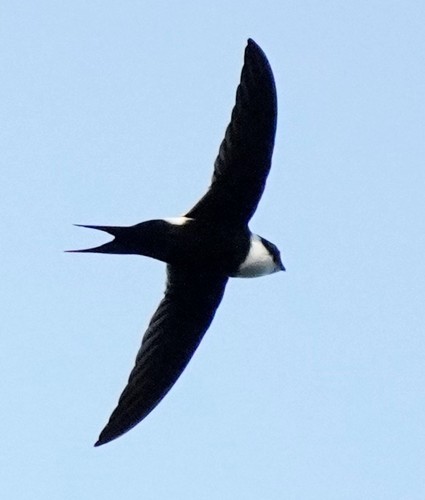
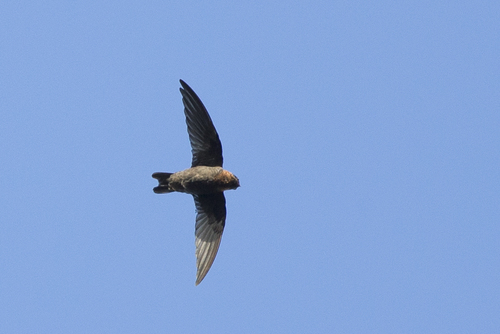
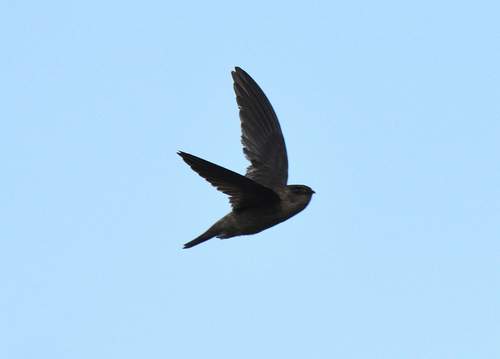
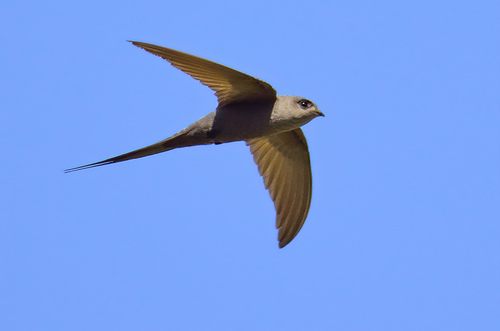
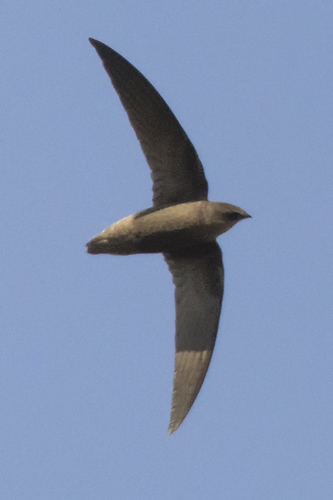
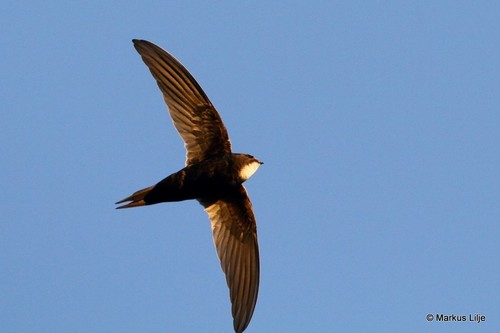
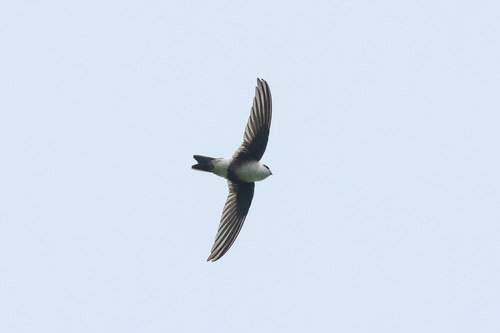
The Andean swift (Aeronautes andecolus) is approximately 14 cm (5.5 in) long. It has sharply pointed wings and a long, deeply forked tail, and males and females are identical in appearance. The nominate subspecies has mostly black upperparts with a white collar and a white band on the rump. Its face and underparts are mostly white to off-white, with mottled buff coloring on the flanks and vent. Subspecies A. a. parvulus is smaller than the nominate subspecies, with very sharply defined borders between its black and white areas. Subspecies A. a. peruvianus is also smaller than the nominate; it has a shorter, less deeply forked tail, purer white plumage, and darker undertail coverts. The three subspecies have separate ranges across the Andes. A. a. parvulus, the northernmost subspecies, occurs on the western slope of the Andes from Peru's Cajamarca Department south into the far northern Tarapacá Region of Chile. The nominate A. a. andecolus ranges from central Bolivia south to Río Negro Province in west central Argentina. A. a. peruvianus is limited to the east slope of the Andes in southeastern Peru. The Andean swift primarily inhabits semi-arid montane scrub, though it can also be found in both drier and more humid areas, and is occasionally seen over forested slopes. Its main elevation range is 2,500 to 3,550 m (8,200 to 11,600 ft) in Peru and Bolivia, and 2,000 to 2,500 m (6,600 to 8,200 ft) in Argentina. Individuals have been recorded above 4,100 m (13,500 ft) in Peru.