About Aeromachus pygmaeus (Fabricius, 1775)
Scientific name: Aeromachus pygmaeus (Fabricius, 1775)
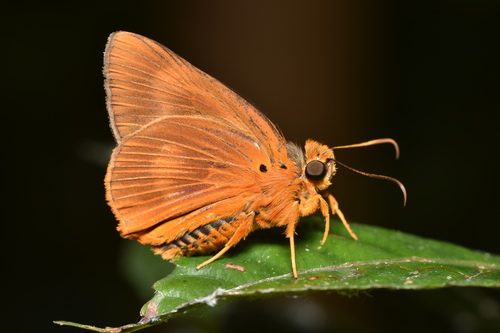
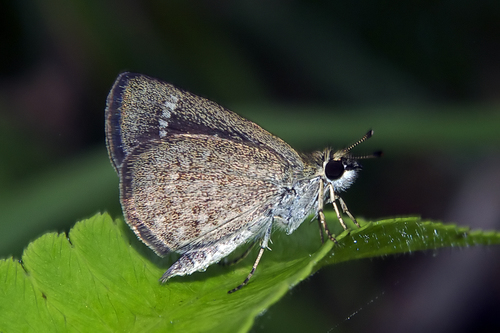
Description of the male: The upperside of the wings is uniform olive-brown, with no distinct markings. In some individuals, there are very faint hints of discal and sub-marginal marks. The cilia match the color of the wings, and are slightly paler at the tips. The underside of the wings is paler than the upperside. A small whitish spot is located at the end of the cell, and this spot is sometimes absent. There is an indistinct, outwardly curved, thin whitish discal band that runs from near the costa to halfway down the wing. The upper and outer portions of the wing are sparsely covered with tiny white scales. The entire hindwing is covered in tiny white scales, with faint traces of an outwardly curved whitish discal band, and a very indistinct series of sub-marginal spots that are slightly darker than the base wing color. The antennae are black, ringed with white; the underside of the club is whitish everywhere except its tip. The palpi, head, and upper body match the wing color, and are whitish on the underside. Females are similar in appearance to males. The larvae feed on Polytrias indica, Cyrtococcum trigonum, and Stenotaphrum secundatum.