About Aequorea victoria (Murbach & Shearer, 1902)
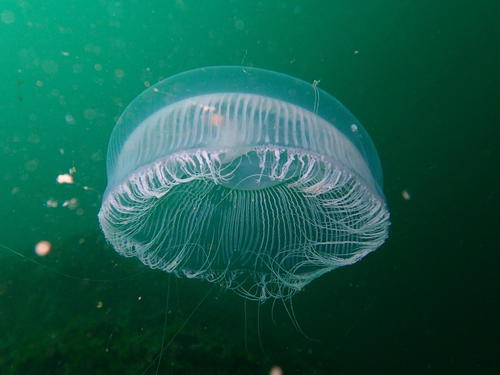
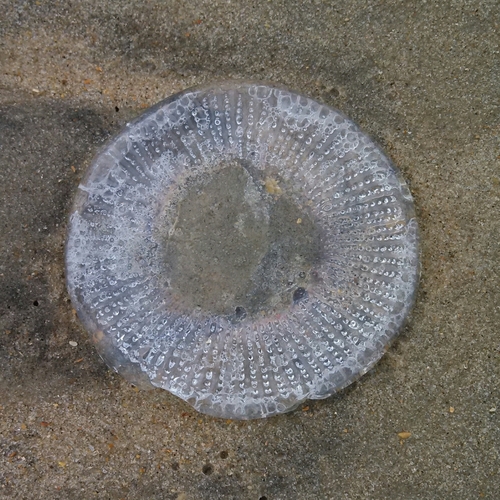
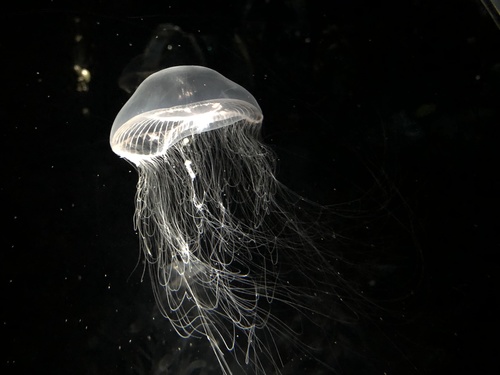
Aequorea victoria is almost entirely transparent and colorless, and can sometimes be hard to distinguish. This hydromedusa has a highly contractile mouth and manubrium at the center of up to 100 radial canals that extend to the bell margin. The bell margin is lined with uneven tentacles; fully grown specimens can have up to 150 tentacles. These tentacles bear nematocysts that help capture prey, and the nematocysts have no effect on humans. Specimens larger than 3 cm usually have gonads for sexual reproduction, which run along most of the length of the radial canals, and appear as whitish thickenings along the radial canals. A muscular velum rings the bell margin, a feature typical of hydromedusae that aids locomotion via muscular contraction of the bell. Larger specimens often host symbiotic hyperiid amphipods that attach to the subumbrella, and occasionally even live inside the gut or radial canals.
Identifying different species of Aequorea can be quite difficult, because identifications are mostly based on morphological characteristics: number of tentacles, number of radial canals, number of marginal statocysts, and size. These features are fairly flexible, and the number of tentacles and radial canals increases with size in all Aequorea species. One additional species, Aequorea coerulescens, is sometimes found in the same geographic range as Aequorea victoria. While A. coerulescens is generally found offshore in the eastern Pacific Ocean, rare specimens have been collected in central California and Friday Harbor, North Puget Sound. Though morphologically similar to Aequorea victoria, A. coerulescens is larger, around the size of a dinner plate, and has many more radial canals. Individuals that fall between the two forms in size also have intermediate appearance, making morphological identification very difficult.
This species is thought to be the same species as the Aequorea aequorea studied by Osamu Shimomura, the discoverer of green fluorescent protein (GFP). Shimomura, alongside Martin Chalfie and Roger Y. Tsien, was awarded the 2008 Nobel Prize in Chemistry for the discovery and development of GFP as an important biological research tool. Originally, the name A. victoria was used for the Pacific variant of the species, while A. aequorea was used for specimens found in the Atlantic and Mediterranean. The species name used for GFP purification was later disputed by M.N. Arai and A. Brinckmann-Voss in 1980, who chose to separate the two populations based on 40 specimens collected around Vancouver Island. Shimomura notes that this species as a whole shows great variation: from 1961 to 1988 he collected around 1 million individuals in the waters surrounding the University of Washington's Friday Harbor Laboratories, and recorded pronounced variation in the form of the jellyfish across these specimens.
Aequorea victoria is found along the North American west coast of the Pacific Ocean, ranging from the Bering Sea to southern California. The medusa stage of its life cycle is a pelagic organism, budded off from a bottom-dwelling polyp in late spring. Medusae can be found floating and swimming both nearshore and offshore in the eastern Pacific Ocean, and the species is particularly common in Puget Sound.