About Aequorea forskalea Péron & Lesueur, 1810
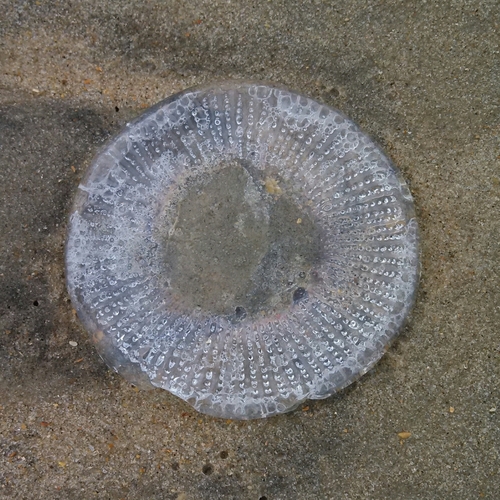
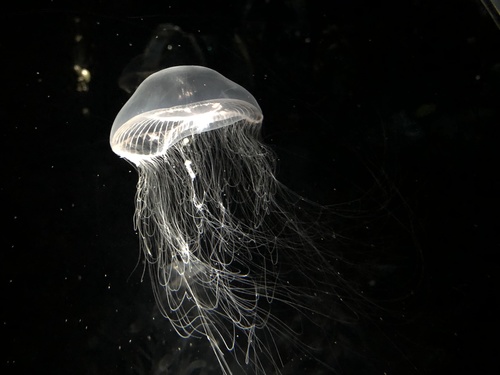
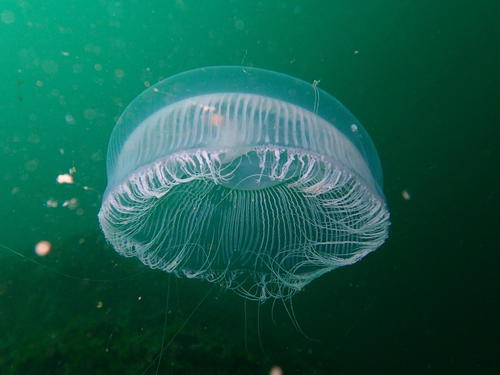
Aequorea forskalea, a hydrozoan species, has the following morphological characteristics during its medusa life stage. Its umbrella is large, thick near the center and gradually thinning toward the margin, and can reach up to 175 mm (6.9 in) across. The stomach occupies approximately half the total width of the umbrella disc. Most individuals have between 60 and 80 radial canals, but recorded counts range from fewer than 60 up to 160. The gonads extend along almost the entire width of the organism. The number of tentacles is usually less than the number of radial canals, but can vary from half to twice the number of radial canals. Small bulbs are scattered across the umbrella's marginal region, while the bulbs on the tentacles are conical and elongated. The species has excretory pores on short papillae, and 5 to 10 statocysts between each pair of adjacent radial canals. Aequorea forskalea contains the bioluminescent protein aequorin, but like all species in the Aequorea genus, it is almost completely colorless.
Aequorea forskalea has a complicated taxonomic history. It was first recorded in 1775 under the name Aequorea aequorea, and it was not formally described and named Aequorea forskalea by Péron & Lesueur until 1810, and it is considered synonymous with many records published between 1775 and 1938. In 1953, marine biologist Frederick Stratten Russell confirmed in his book *The Medusae of the British Isles* that Aequorea forskalea is the accepted name for this species, and that the name A. aequorea refers to an unidentifiable species. It is very similar to Aequorea victoria, a species common in the Pacific Ocean. In 1980, the two were distinguished by geographic range: A. victoria is the Pacific variant, while A. forskalea designates variants found in the Atlantic and Mediterranean.
This is a pelagic species originally discovered in offshore waters of the Mediterranean Sea. It is widely distributed across suitable temperate and subtropical regions. Documented locations include the Southwest Atlantic near northern Patagonia, the west coast of Southern Africa, and waters from the Galician coast through the North Sea to the Norwegian Sea. The species most often occurs on the mid-continental shelf at depths greater than 150 meters (490 ft), but blooms have been recorded in coastal regions as shallow as 100 meters (330 ft). It is typically found in waters with temperatures between 13 and 22 °C (55 to 72 °F).