About Aeonium haworthii Salm-Dyck ex Webb & Berthel.
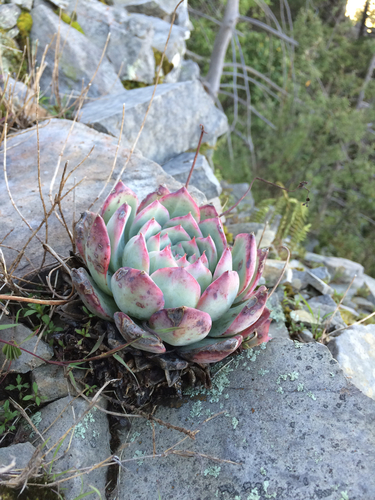
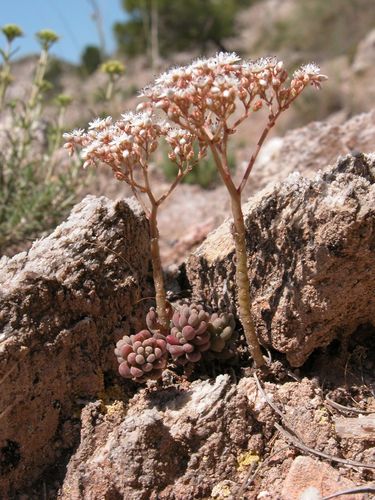
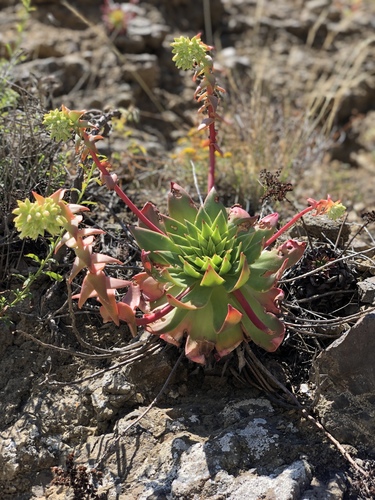
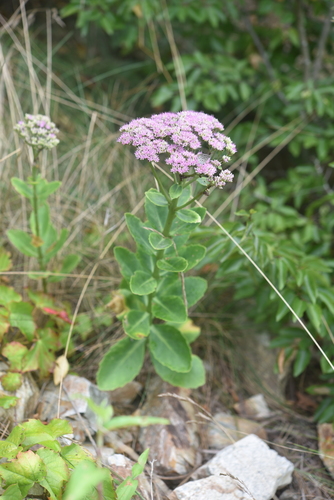
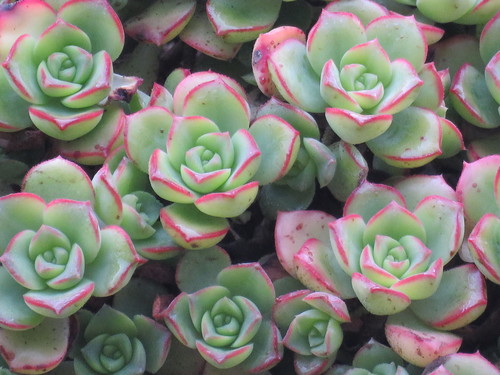
Aeonium haworthii Salm-Dyck ex Webb & Berthel. grows as a densely branched small shrub, reaching heights of up to 60 centimeters. Its almost bare, somewhat mesh-like ascending, hanging, or winding shoots are 3 to 6 millimeters in diameter. The rather flat rosettes these shoots produce reach 6 to 11 centimeters in diameter, with inner leaves growing more or less upright. The leaves are obovate, green or yellowish-green, often strongly covered in a bluish coating, and almost bare. They measure 3 to 5.5 centimeters long, 1.5 to 3 centimeters wide, and 0.25 to 0.4 centimeters thick. They are pointed and tapered toward the tip, with a wedge-shaped base. The leaf margin is lined with curved 0.4 to 0.8 millimeter long hairs resembling eyelashes, and leaves often have reddish variegation along their edges. This species produces panicles of cream-colored pointed flowers in spring. The loose, hemispherical inflorescence measures 6 to 16 centimeters long and 6 to 16 centimeters wide, with a 1 to 9 centimeter long peduncle. Flowers, which have 7 to 9 parts, grow on a 2 to 12 millimeter long bare flower stem. Sepals are hairless. The pale yellow to whitish, pink-variegated lanceolate pointed petals are 7 to 9 millimeters long and 1.2 to 1.8 millimeters wide. Stamens range from almost glabrous to sparsely covered in soft fine hairs. Aeonium haworthii is native to the Canary Islands and northern Africa, and has been introduced to other areas with similar climates, such as Southern California. In the United States, it is suitable for outdoor growing in USDA hardiness zones 9 to 11. It is drought tolerant and prefers full sun. It is sometimes susceptible to infestation by aphids and mealybugs. It is a sand-dwelling beach plant, a subshrub with rough woody stems and rosettes of thick red-edged green leaves that are triangular, diamond-shaped, or spade-shaped.