About Aeonium arboreum (L.) Webb & Berthel.
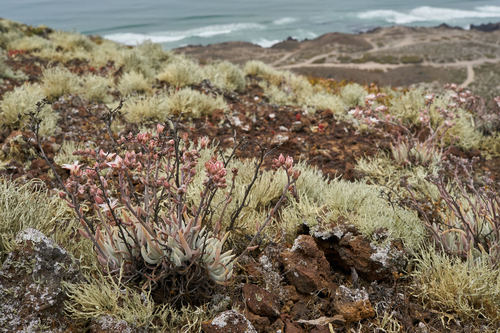
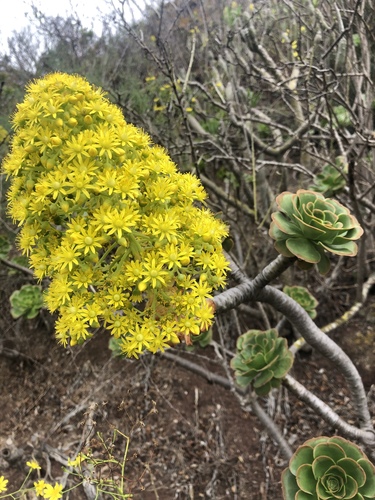
Aeonium arboreum (L.) Webb & Berthel. is a subshrub with little branching that can grow up to 2 meters tall. Its stem axes are roughly upright or ascending, smooth, not net-patterned, and have a diameter between 1 and 3 centimeters. Leaves grow together in flattened rosettes at the tips of the stem axes, with rosette diameters ranging from 10 to 25 centimeters. Young leaves are tightly packed together. The leaf blade is obovate to oblate lanceolate, pointed at the apex and wedge-shaped at the base. It measures 130 to 380 mm (5 to 15 inches) long, 25 to 115 mm (1 to 4+1⁄2 inches) wide, and 1.5 to 3 millimeters thick. The glossy leaf surface is green, often purple-tinged, and is almost hairless. The leaf margin is lined with curved, eyelash-like hairs. The inflorescence is conical to ovate, 10 to 25 centimeters long and 10 to 15 centimeters in diameter, with an inflorescence stem that is 130 to 510 mm (5 to 20 inches) long. Flowers grow on 2 to 12 millimeter long, slightly fuzzy flower stems. Sepals are also slightly fuzzy, with a pointed tip and wedge-shaped base, and are smooth, shiny, and green, red, or purple. The petals are yellow, narrow oblong to lanceolate, pointed, and measure 5 to 7 millimeters long and 1.5 to 2 millimeters wide. Stamens are hairless. This species produces leaf rosettes and large pyramidal panicles of bright yellow flowers in spring. This plant is endemic to the western Canary Islands: Tenerife, La Palma, El Hierro, La Gomera, and Gran Canaria. Populations found on the Iberian Peninsula, the Moroccan coast, and the Mediterranean are generally considered neophytes. In colder temperate regions, it must be grown under glass; in temperate regions with mild winters, it is perennial. In its natural range, Aeonium arboreum grows in sunny or slightly shaded locations on weathered volcanic soil. The purple cultivar 'Zwartkop' (also called 'Schwartzkopf') has received the Royal Horticultural Society's Award of Garden Merit. A variegated cultivar is grown under the name 'variegatum'.