About Aeoliscus strigatus (Günther, 1861)
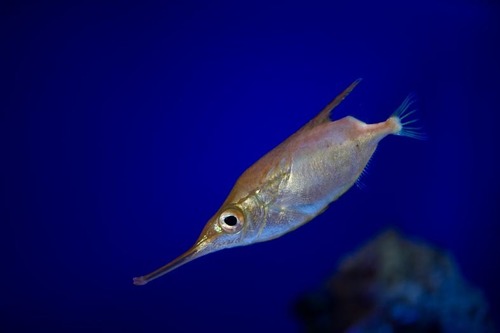
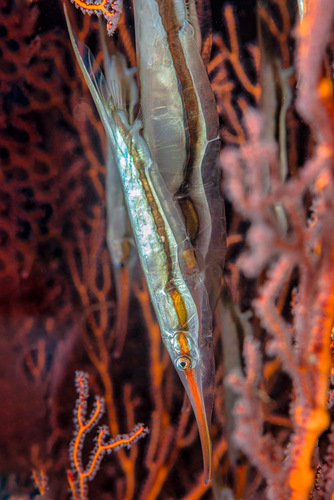
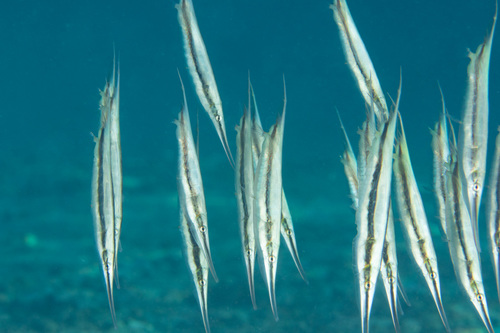
This species, commonly called razorfish, has the scientific name Aeoliscus strigatus (Günther, 1861). The razorfish is easy to identify by its unique body shape and its habit of moving in synchronized groups with its head pointing downward. It is a small fish that reaches a maximum length of 15 cm (5.9 in). Its body is elongated and ends in a thin, long beak. Its fins are significantly reduced in size and transparent. The dorsal surface of the razorfish is covered by protective bony plates; these plates extend past the end of the body and over the tail fin, which ends in a sharp spine. A black to brown median stripe runs along the entire length of the fish, and crosses over its eyes. The fish’s body color varies based on its habitat. In seagrass environments, the body’s base color may be greenish-yellow with light brown stripes. In open areas such as sand patches, rubble, or near coral reefs, the body color is light silver with a black to brown stripe. No sexual dimorphism has been documented in this species. Ecologically, the razorfish feeds primarily on small brine shrimp and other small invertebrates, and it is also known to eat tiny crustaceans. In the wild, razorfish have been observed hiding among the spines of sea urchins, using this behavior both for defense and for hunting. When threatened by larger fish, the razorfish darts to a nearby sea urchin or staghorn coral for protection. Razorfish hunt among sea urchin spines, particularly those of the genus Diadema, and wait for small invertebrates that feed on the urchins. When prey approaches, the razorfish darts out to attempt to catch it. This species is oviparous; its eggs and larvae are pelagic. Juveniles settle when they grow to 20 millimetres (0.79 in) in length, and most often choose to live among the spines of Diadema sea urchins.