About Aeolidiella alderi (Cocks, 1852)
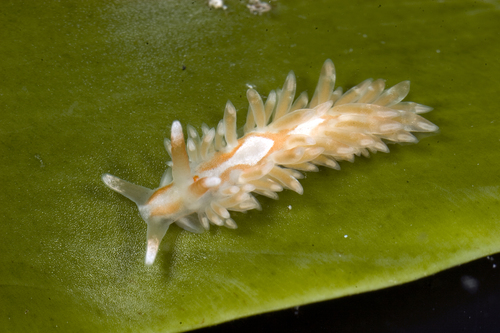
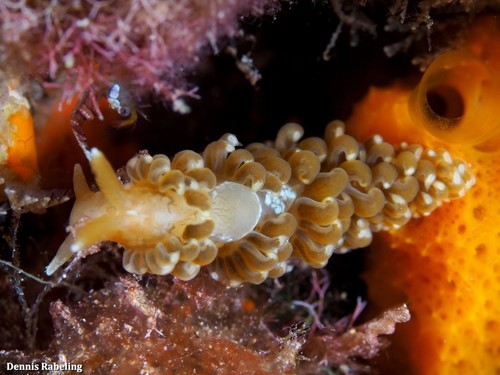
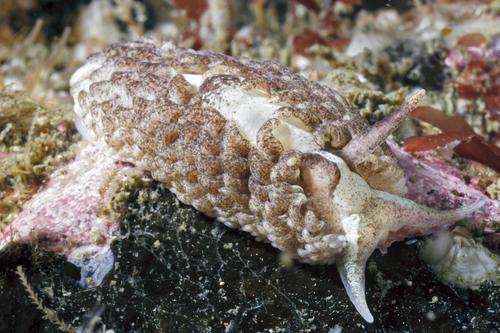
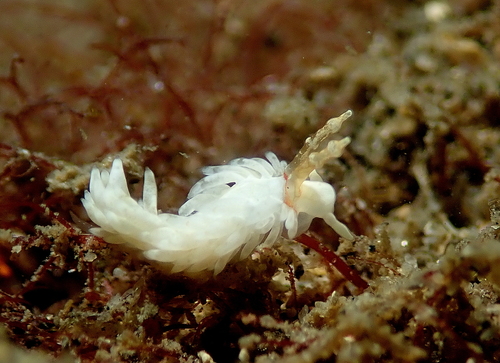
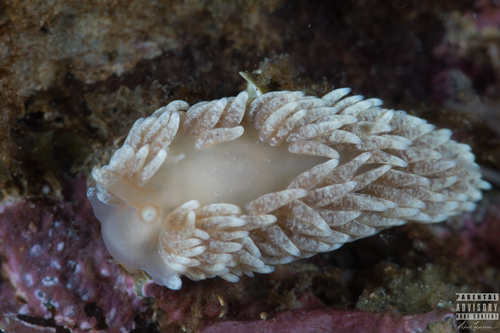
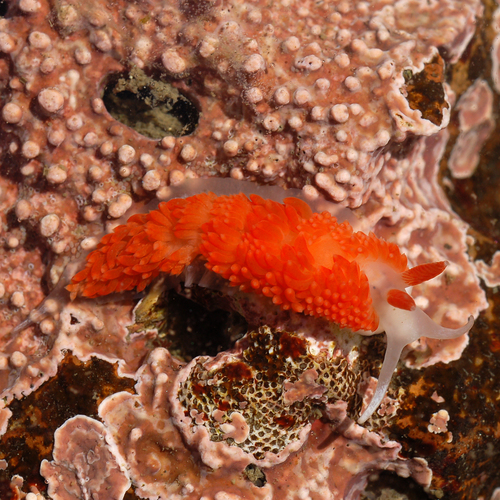
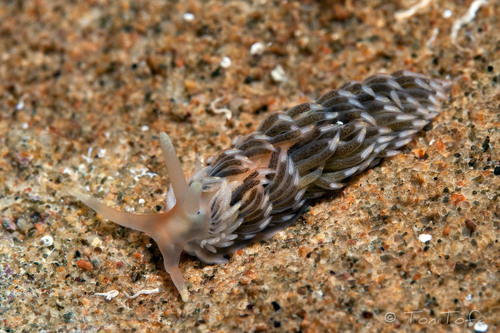
Aeolidiella alderi (Cocks, 1852) is a small nudibranch that reaches a maximum length of 37 mm (1.5 in). Its body is flattened and broad, but not as wide as the bodies of Aeolidia papillosa and Aeolidia filomenae. On its head, the pair of oral tentacles are longer than the rhinophores. The dorsal surface of its body holds up to 16 oblique rows of cerata on each side. Cerata are outgrowths of the body wall that increase surface area available for respiration, and they contain extensions of the gut, so their colour changes based on what the nudibranch has eaten. The first row of cerata have reduced digestive gland extensions, are white, and form a distinct collar. Each ceras is tipped with a cnidosac that holds stinging cells. These stinging cells come from the sea anemones the nudibranch eats, and pass through the nudibranch's body without being digested. This species was first described from specimens collected in England. It has been recorded in the North Atlantic Ocean off the coast of Ireland, as well as in the North Sea and the Mediterranean Sea. It is a shallow water species that lives in the intertidal zone, found under boulders and in rock pools. Aeolidiella alderi is a carnivorous species that feeds on sea anemones, and it shows a preference for Cereus pedunculatus, Diadumene cincta, and Sagartia species including Sagartia elegans and Sagartia troglodytes. It also feeds on Metridium dianthus, Sagartiogeton laceratus, Paractinia striata, Actinothoe sphyrodeta, Aiptasia mutabilis, Anemonia viridis and Aulactinia verrucosa. The nudibranch's rhinophores are sensory structures that can detect chemicals dissolved in surrounding water, allowing the animal to locate its prey. Most predators avoid sea anemones because of their defensive stinging cells, so A. alderi uses a specialized hunting approach. It approaches its prey very cautiously, moving gradually closer, and extends the cerata that form its collar to two or three times their normal resting length. When it is within a fraction of a millimetre of the anemone, it discharges the cnidosacs in its collar cerata into the anemone's column. This poisons the anemone's tissues and causes necrosis, after which the nudibranch can feed. This nudibranch is hermaphroditic. It produces large eggs, which it lays in a spiral string of mucus on the substrate. Development is direct, with no free-swimming larval stage; newly hatched young simply crawl away from the egg mass. Juveniles do not have any cerata when they hatch, and cerata develop as the individual grows. Reproduction can occur year-round, and juveniles reach sexual maturity after several months of growth.