About Aeolidia papillosa (Linnaeus, 1761)
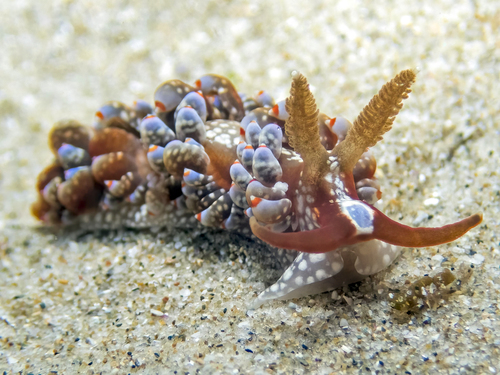
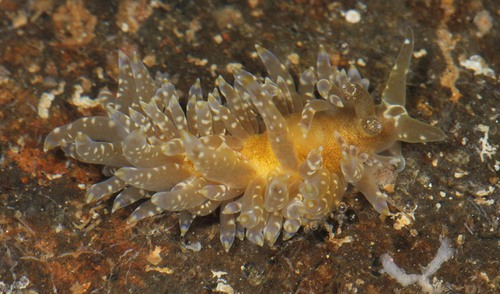
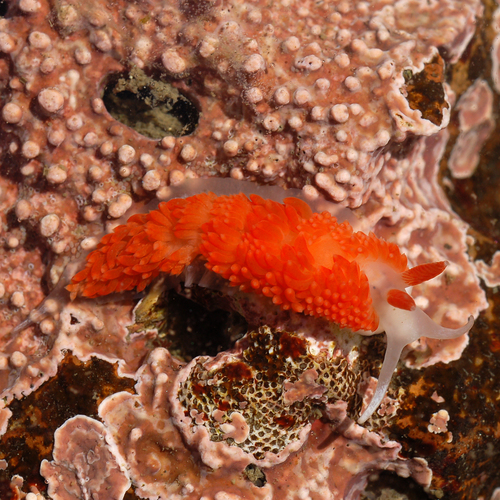
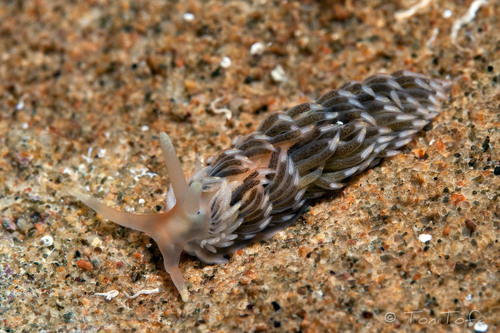
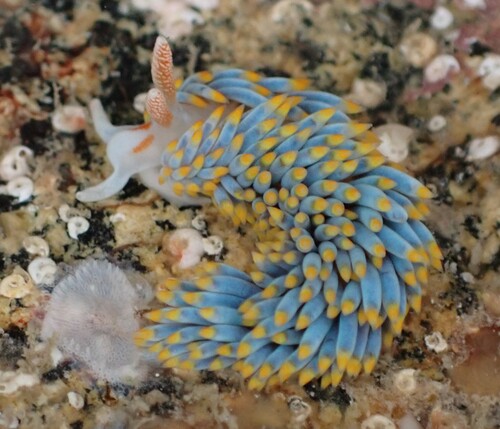
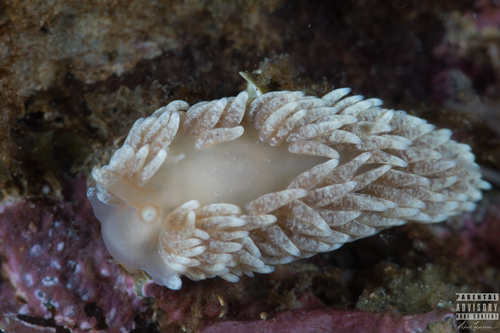
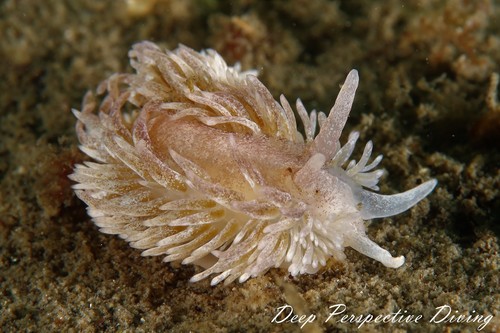
Aeolidia papillosa can be easily identified by the large number of cylindrical cerata that cover most of its body, leaving only a triangular area that extends from the rhinophores to the mid dorsum exposed. Its color is variable, and it usually has speckled darker markings on the head and back regions. To distinguish it from other Aeolidia species, A. papillosa has a distinct V-shaped pattern on its head that extends from one oral tentacle to the opposite tentacle. Adult A. papillosa grow up to 120 mm in length.
This nudibranch species lives in cold-temperate waters of the Northern Hemisphere, found along the Atlantic coast of the British Isles and Northern Europe, the Atlantic coast of North America, and the north Pacific coast of North America. Recent research has shown that this species has a more restricted distribution than originally thought, as specimens previously classified as A. papillosa from California, France and Chile actually belong to three separate species.
All members of the order Nudibranchia are hermaphrodites, with fully developed male and female reproductive organs. For A. papillosa, self-fertilization is rare, and the species predominantly reproduces via copulation.
Members of the family Aeolidiidae, along with other nudibranch families, are often studied for their ability to adaptively reuse stinging nematocysts from their cnidarian prey, specifically sea anemones in the genera Actinia, Anemonia, Metridium, Sagartia and Urticina, for their own defense. Another food source for A. papillosa is zooxanthellae, dinoflagellates that live in a mutualistic relationship within the nudibranch and provide nutrition to its tissues through photosynthesis. A. papillosa practices what is called "ingestive conditioning", where it consumes nematocysts from its prey in response to the presence of predators in the same environment.