About Aegotheles cristatus (Shaw, 1790)
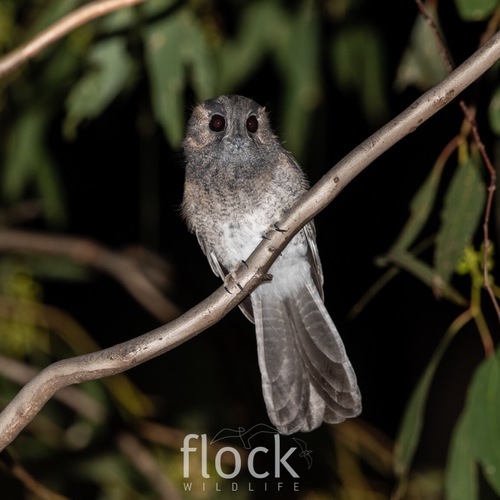
The Australian owlet-nightjar (Aegotheles cristatus (Shaw, 1790)) measures 21–25 cm in length, and is a small to medium-sized owlet-nightjar. It has grey upperparts, a white front marked with bars, and distinct dark and pale patterning on its head. It has large dark eyes that do not reflect light when illuminated, which differs from the trait of many other nocturnal birds. In northern Australia, females may have a rufous color morph. It is possible that males in this region also have a rufous morph, but it is far less distinct than the morph seen in females. This rufous morph only occurs in northern Australia, and is not found in coastal south-eastern Australia. Newly hatched chicks are covered in dense white down, which is replaced by grey down after approximately 10 days. This grey down is later replaced by juvenile plumage. Juvenile birds are similar to adults, but have slightly more spotting, shorter face bristles, and blurred markings on the face and nape. Populations living in deserts have overall paler plumage.
Australian owlet-nightjars are adapted to live in open woodland, with more pointed wings and larger feet, unlike most other members of their family that live in dense forest. However, some individuals of this species do live in dense forest habitat in Queensland and New Guinea. This species is widespread across Australia, and it is hollow-dependent, meaning it uses tree hollows for both roosting and nesting. In Australia, it can also be found in suburban and urban-fringe environments. Waterways and rivers are important to this species; a study in Australia found that Australian owlet-nightjars are more likely to occur in areas with waterways than in areas without. They occupy a variety of habitats including open woodland, mallee scrub, and tropical woodlands, and are occasionally found in mangroves, open grasslands, and rainforests. In New Guinea, this species is most commonly found in savannah, while in Australia it prefers open mature woodland and habitats that contain eucalyptus and acacia.
Australian owlet-nightjars nest mainly in tree holes, and may also use other holes and crevices. Both members of a breeding pair add leaves to the nesting site. It is thought that frequent addition of eucalyptus leaves serves as a beneficial insecticide. Breeding pairs are believed to mate for life, and breeding occurs between August and December. Females lay three or four eggs, which they incubate for just under a month. Both adult parents feed the chicks, which fledge after one month. Young birds are reported to stay near their parents for several months after fledging.

