About Aegopodium podagraria L.
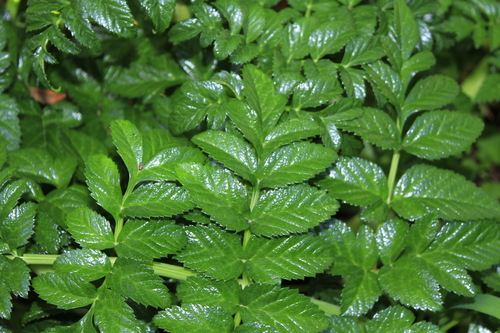
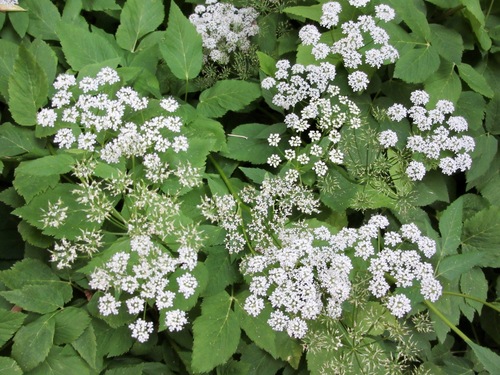
Aegopodium podagraria L. is a herbaceous perennial that grows up to 1 metre (3+1⁄2 ft) tall from underground rhizomes. Its stems are erect, hollow, and grooved, while upper leaves are ternate, broad, and toothed. It flowers in spring and early summer, producing numerous flowers arranged in an umbrella-shaped compound umbel, which is split into smaller individual umbels called umbellets. Each umbellet holds 15 to 20 pedicels (rays), each topped with one small, five-petaled white flower. Many types of pollinating insects visit these flowers. Its small fruits, which develop in late summer and autumn, have long curved styles. Aegopodium podagraria is widely distributed across the temperate zone of western Asia and all of mainland Europe. It has been introduced to many other regions, including Ireland, the United Kingdom, the United States, Canada, Australia (including Tasmania), New Zealand, and Japan. In its native Eurasia, it serves as a food plant for the larvae of some Lepidoptera species, including the dot moth, grey dagger, and grey pug. It is not the only host plant for any of these moth species. The plant's tender leaves can be used as a spring leaf vegetable similar to spinach, and this use dates back to antiquity. It is commonly added to soup, and young leaves are preferred for use as a pot herb. It is best harvested from when it first emerges (as early as February in the UK and other parts of northern Europe) until just before it flowers, between May and June. If harvested after flowering begins, it has a pungent taste and causes a laxative effect. Pinching out flower buds prevents flowering, allowing the plant to remain edible for use as a pot herb when harvested sparingly. It has also been used as a medicinal herb to treat gout and arthritis. Historical records indicate the Romans introduced it to Great Britain as a food plant, while monks brought it to Northern Europe as a medicinal herb. Today, it can still be found growing in patches around many European monastic ruins, and descriptions of its use appear in monastic writings such as Hildegard von Bingen's Physica. As a member of the Apiaceae family, its flowers can be mistaken for extremely toxic species like poison hemlock and hemlock water dropwort, so checking leaf characteristics is necessary for a confident identification. A variegated cultivar of Aegopodium podagraria is grown as an ornamental plant. However, this plant is banned in several U.S. states due to its invasive nature, and seeds produced by the variegated form can grow back into the more aggressive original green form.