About Aegolius funereus (Linnaeus, 1758)
The boreal owl (Aegolius funereus) is a small owl with a large head and long wings. Both sexes have similar appearance, though females are consistently larger than males. Males typically measure 21–25 cm (8–10 in) in body length with a 55–58 cm (22–23 in) wingspan, and weigh 93–139 g (3.3–4.9 oz). Females measure 25–28 cm (10–11 in) in body length with a 59–62 cm (23–24 in) wingspan, and weigh 132–215 g (4.7–7.6 oz).
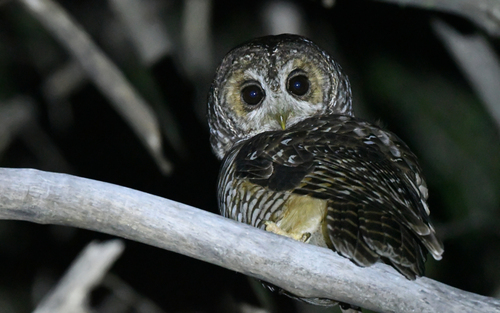
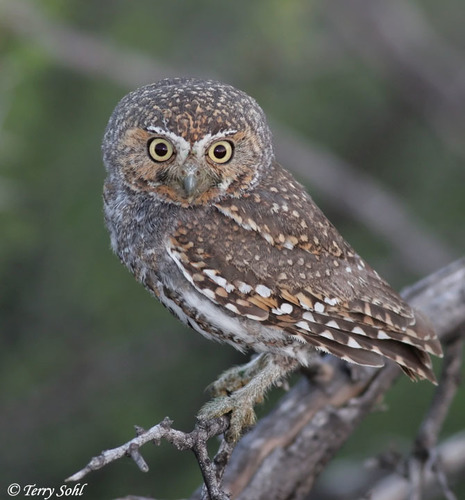
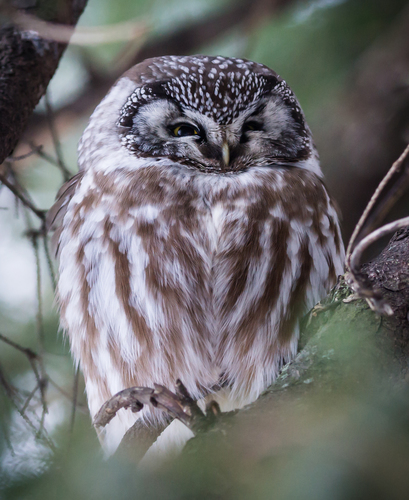
Adult boreal owls have brown plumage on their upper side, with prominent pearly-white spots across the back and wings — this marking gives the species its Danish name perleugle, meaning "pearl owl". Underparts are whitish with rust-coloured streaks. The large head holds yellow eyes; the olive-brown crown has small white spots and larger central spots. A dull white facial disc is edged with a dark border, and marked with white "eyebrows" that often give the owl a "surprised" expression. The tail is made of olive-brown feathers with narrow bars, while flight feathers are dark olive-brown with contrasting white spots. Primaries usually have up to five rows of white spots, and the tail has three distinct rows of spots; unlike other owl species, these spots stay separated even when the tail is folded tightly. The beak is light yellow, which differs from the dark beak of its close relative the northern saw-whet owl. Multiple ear bones are asymmetrical, a trait that improves the owl's hunting success. Boreal owls have a relatively silent, straight flight.
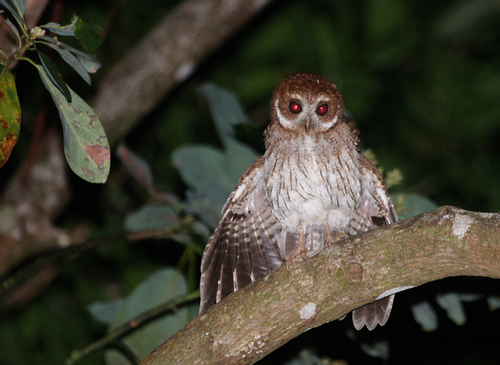
Juvenile boreal owls at around 3 weeks old have entirely dull, chocolate-brown plumage on both upperparts and underparts, with a dark brown facial disc bordered by black, plus white markings near the bill. After fledging, their plumage remains mostly similar but gains white markings on the neck, scapulars, flight feathers, and tail. Juveniles develop a broad white "X" shape between the eyes, distinct white streaks along the face, and a cream-coloured belly and flanks streaked with dark grey-brown.
The boreal owl breeds in dense boreal forests, subalpine forests, and mixed woodlands. It prefers old-growth forests, as these provide shelter from avian predators and an abundant supply of prey. Breeding habitats include boreal forests of black spruce, white spruce, birch, and aspen across northern North America and the Palearctic, as well as in mountain ranges such as the Alps and the Rocky Mountains. Nests are located in aspen and mixed forests, while individual boreal owls roost in conifers around 6 metres high. This species can travel long distances, but typically breeds within 500 metres of their natal site. Males have higher site fidelity than females and occupy stable year-round home ranges. Northern populations may migrate south when snow depth is high and prey availability is low, but they eventually return to their breeding grounds.
This small owl eats mainly voles and other small mammals including mice, chipmunks, other squirrels, gophers, moles, shrews, and bats. It also preys on birds, small amphibians, insects such as beetles, and other invertebrates. In North America, it has been observed hunting southern red-backed voles, western heather voles, jumping mice, northern pocket gophers, and northern flying squirrels; recorded bird prey includes dark-eyed juncos, American robins, and redpolls. The boreal owl is largely nocturnal, though in the northernmost parts of its range it must hunt during daylight due to very short summer nights. It is an ambush predator, and does not pursue prey; instead it waits until prey comes within 10 metres of its hunting perch. Its extremely asymmetrical skull allows it to pinpoint sound in both horizontal and vertical directions, letting it capture prey hidden under snow and dense vegetation.
Human activities impact the boreal owl through timber harvest. Logging has a negative effect on prey availability, foraging efficiency, and access to suitable nesting sites. Since the 1990s, significant population declines in northern Europe have been linked to clear-cutting. Pesticides from agricultural and forestry runoff also damage the species' health. Slow forest succession in spruce-fir ecosystems disrupts the recovery of critical habitat, harming the species' ability to thrive. In Eurasia, the decline of the black woodpecker (Dryocopus martius) has also led to fewer available nesting cavities for boreal owls.