About Aegolius acadicus (J.F.Gmelin, 1788)
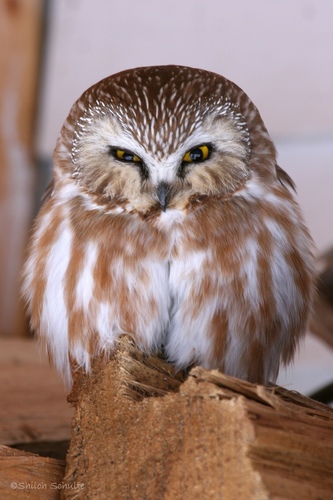
This species, the northern saw-whet owl, has the scientific name Aegolius acadicus (J.F.Gmelin, 1788). The scientific description of one of its subspecies was completed in 1896 by Rev. John Henry Keen, a missionary based in Canada. Adult northern saw-whet owls measure 17–22 cm (6.7–8.7 in) in length, with a wingspan of 42–56.3 cm (16.5–22.2 in). Their weight ranges from 54 to 151 g (1.9 to 5.3 oz), with an average weight of around 80 g (2.8 oz), making them one of the smallest owls found in North America. They are similar in size to the American robin, which averages 78.5 g. Northern saw-whet owls do not have sexual dimorphism in their plumage, so individuals are most often sexed by their size dimorphism, as females are larger than males. On average, females weigh 100 g, while males weigh an average of 75 g. Porphyrin pigments are present in the flight feathers of northern saw-whet owls; when exposed to ultraviolet light, feathers on the ventral side of the wing fluoresce a bright neon pink. This fluorescence is used to estimate molt stage and age in adult owls. The northern saw-whet owl has a round, light white face marked with brown and cream streaks, a dark beak, and yellow eyes. Its underparts are pale with dark shaded areas, while its upper parts are brown or reddish with white spots. Juvenile northern saw-whet owls have dark brown heads and wings, and a tawny rust-colored breast and belly, with a distinct white Y-shaped marking between their eyes. Northern saw-whet owls can be confused with boreal owls, but can be told apart by their larger size, bill color, and lack of a spotted forehead. Cornell Lab's All About Birds entry describes these small owls as common and widespread, but their secretive nature makes them hard to spot and makes it difficult to track population trends. Partners in Flight estimates the global breeding population of northern saw-whet owls stands at 2 million, and rates the species 8 out of 20 on the Continental Concern Score, indicating it is a species of low conservation concern. Even so, the species' overall population has likely declined over past decades due to habitat loss. Local populations have fared even worse in areas including North Carolina, South Dakota, and the Queen Charlotte Islands (Haida Gwaii archipelago) of British Columbia, which hosts an endemic subspecies. Northern saw-whet owls will readily use nest boxes, which can be deployed to offset the loss of natural nesting sites. There are two widely recognized subspecies of the northern saw-whet owl: Aegolius acadicus acadicus, which is found throughout most of North America, and the non-migratory Aegolius acadicus brooksi, which is endemic to the Haida Gwaii archipelago of British Columbia. A. a. brooksi has darker, buffier plumage than the nominate subspecies, and has been proposed for recognition as a separate species called the Haida Gwaii saw-whet owl. Isolated populations of northern saw-whet owls living in the Allegheny Plateau and Southern Appalachian Mountains have been found to be morphologically different from owls in the central part of the species' range, and are just as genetically distinct from the nominate subspecies as A. a. brooksi from British Columbia. Northern saw-whet owls inhabit coniferous forests across North America, and may also live in sometimes mixed or deciduous woodlands. During the breeding season, most individuals nest in dense coniferous forests near wetlands, but at the southern edge of their range in the eastern United States they may also breed in mixed-deciduous forests. Wintering northern saw-whet owls prefer conifer stands or shrub thickets near water, but may occasionally be found in mixed-deciduous forest. They are secondary cavity nesters, which means they do not create their own nest cavities, and instead rely on naturally formed holes or cavities excavated by other animals. Some northern saw-whet owls are permanent residents, while others migrate south for winter or move down from higher elevations. Their range covers most of North America south of the boreal forest, including southeastern and southcentral Alaska, southern Canada, most of the United States, and the central mountains in Mexico. Some populations have recently begun expanding further southeast into Indiana and neighboring states. A study by Buidin et al. examining how far north the species breeds found that northern saw-whet owls can breed north of 50° N, further north than has ever been recorded before. The species has a very extensive range, and can even breed in the far north that most other bird species only migrate to for breeding. It is an adaptive species that survives well in cold conditions. There are two semi-isolated permanent populations in the eastern United States. The first is located along the West Virginia border in the Allegheny Plateau. The second lives on high-elevation areas above 4000 ft in the southern Appalachian Mountains of western North Carolina, eastern Tennessee, and southwestern Virginia. While populations are abundant in the northern and western regions of North America, in some counties of North Carolina the species is currently listed as threatened due to the decline of suitable habitat, caused by the loss of boreal forests from hemlock woolly adelgid infestation, logging, and pollution. The northern saw-whet owl has vertically asymmetrical ears with differently shaped ear openings. Because sound reaches each ear at a different time and with different intensity, the owl can locate prey very precisely. This accurate sound localization lets it hunt in complete darkness using only hearing. A study by Beatini et al found that northern saw-whet owls have possible frequency sensitivity ranging from 0.7 to 8.6 kHz, with the best sensitivity falling between 1.6 to 7.1 kHz, which allows the species to hunt in the dark using only sound. The owls hunt by waiting on a high perch at night, then swooping down to capture prey. They mainly eat small organisms, with a strong focus on small mammals. Swengel and Swengel (1992) reviewed ten studies that found northern saw-whet owls eat almost exclusively mammals (88% to 100% of diet by occurrence), with most of these mammals being rodents (85% to 99+% of mammal prey). In their own Wisconsin study, the Swengels found that northern saw-whet owls most often ate deer mice (Peromyscus, ~68% of captured prey), voles (Microtis pennsylvunicus and M. ochrogaster, ~16%), and shrews (~9%, Blarina brevicauda and Sorex cinereus). A similar 1996 study by Holt and Leroux in Montana found that northern saw-whet owls ate more voles than other mammal species, making up 60% of their diet. A 2015 study by Engel et al also found a strong preference for small mammals in the species, at 89% of diet, with 55% of prey being two species of voles. Holt and Leroux compared the feeding habits of northern saw-whet owls to northern pygmy owls, and found the two species have different main prey sources: 98% of the northern saw-whet owl's diet is small mammals, while over one-third of the northern pygmy owl's diet is birds. Their study concluded that both owl species can adapt their foraging depending on available prey and the presence of other predators in their area. Engel et al (2015) compared northern saw-whet owls to long-eared owls during the winter of 1987–1988 at Chain O'Lakes State Park, Illinois, and confirmed the northern saw-whet owl's strong preference for small mammals. The saw-whet owl's diet was more varied in winter, and less concentrated on a single mammal species than the long-eared owl's diet was. At times, northern saw-whet owls will hunt larger prey such as the meadow vole (M. pennsylvanicus). Other mammals that are occasionally preyed on include shrews, squirrels (mostly chipmunks and red squirrels), various other mice species, flying squirrels, moles and bats. Small birds also supplement the diet, with passerines including swallows, sparrows, kinglets and chickadees being preferred prey. However, northern saw-whet owls can even take larger birds up to the size of a rock dove, which is typically about four times as heavy as an adult saw-whet owl. On the Pacific coast, the owls may also eat crustaceans, frogs and aquatic insects. Like many owls, northern saw-whet owls have excellent hearing and exceptional vision in low light conditions.