About Aegithina tiphia (Linnaeus, 1758)
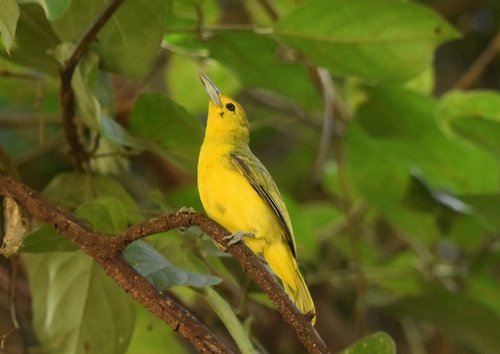
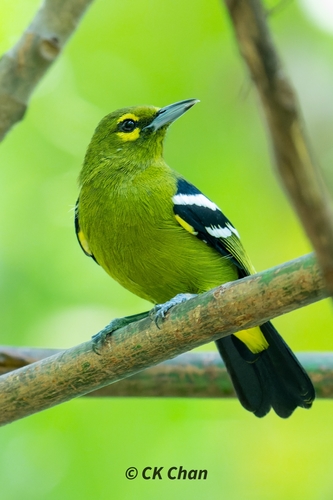
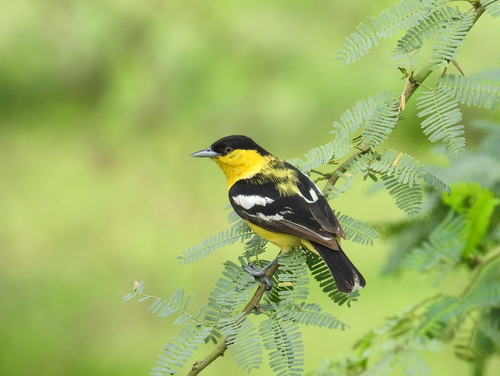
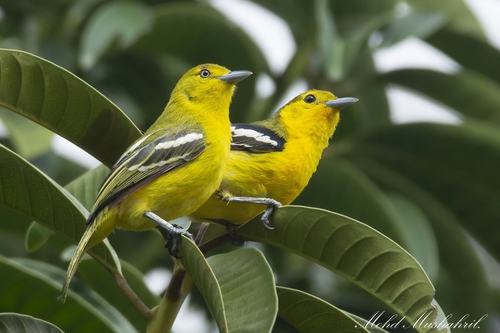
This species, commonly known as the common iora, has a pointed, notched beak with a straight culmen. It is sexually dimorphic. Males have black wings and tails year-round, and gain a black cap and black back during the breeding season. Two white wing bars on males are particularly prominent in breeding plumage. Females have greenish wings and an olive tail. Both sexes have yellow undersides. The distribution of black on the upperparts of breeding males is highly variable. Breeding common iora males can be confused with Marshall's iora, but Marshall's iora always has white tips on its tail. The nominate subspecies occurs along the Himalayas; males from this population are very similar to females, or only have a small amount of black on the crown. The subspecies septentrionalis from northwestern India is brighter yellow than other subspecies. In the northern plains of India, breeding males of the subspecies humei have a black cap and olive upper mantle. Breeding males of multicolor, found in southwestern India and Sri Lanka, have a jet black cap and mantle. Populations in the rest of southern India are intermediate between multicolor and humei, with more grey-green on the rump; this group was formerly classified as deignani, a name now used for the Burmese population. Many other populations across Southeast Asia are recognized as subspecies: philipi from southern China and northern Thailand/Laos, deignani from Myanmar, horizoptera from southern Myanmar and the island chain of Sumatra, cambodiana from Cambodia, aeqanimis from Palawan and northern Borneo, viridis from Borneo, and scapularis from Java and Bali. Common ioras forage in trees in small groups, gleaning insects among branches. They sometimes join mixed-species feeding flocks. Their calls are a mix of churrs, chattering, and whistles, and their song is a trilled wheeeee-tee. They may occasionally imitate the calls of other birds, including drongos. During the breeding season, which occurs mainly after the monsoons, males perform an acrobatic courtship display: they dart up into the air while fluffing all their feathers, especially the pale green feathers on their rump, then spiral back down to their original perch. After landing, they spread their tail and droop their wings. Females lay two to four greenish white eggs in a small, compact cup-shaped nest built from grass, bound with cobwebs, and placed in the fork of a tree. Both the male and female incubate the eggs, which hatch after approximately 14 days. Nest predators include snakes, lizards, crow-pheasants, and crows. Nests may also be brood-parasitized by the banded bay cuckoo. Common ioras moult twice a year, and their wide plumage variation makes separating populations by plumage fairly complicated. A species of Haemoproteus, H. aethiginae, was first described from a common iora specimen collected in Goa.