About Aegithina nigrolutea (G.F.L.Marshall, 1876)
The species status of Aegithina nigrolutea has long been debated. Before 2003, many researchers thought it was only a clinal variant of the common iora, Aegithina tiphia, and it only returned to widespread acceptance as a full species at its original rank in 2003. Even so, its status as a distinct species is still not fully settled, and this question remains a challenge for both geneticists and field workers.
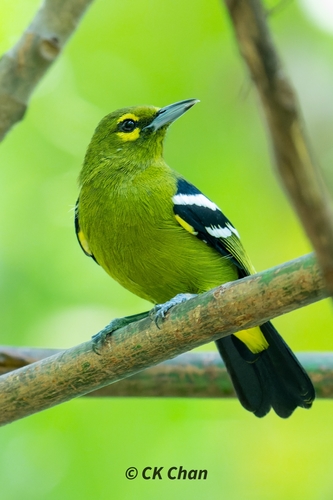
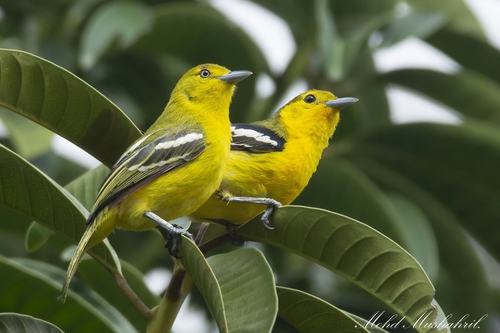
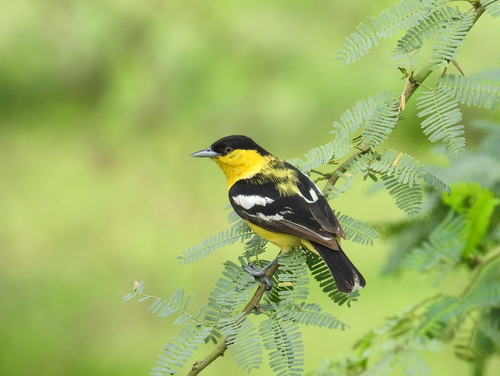
This species can be identified by several diagnostic features that separate it from A. tiphia. It has a shorter wing and shorter tail, and its tertials have white edging that converges broadly at the tip. In contrast, A. tiphia has tertial tips that are black, or only narrowly white at most. A. nigrolutea also has a smaller, shorter bill than A. tiphia from any region of India, and its vocalizations are also different.
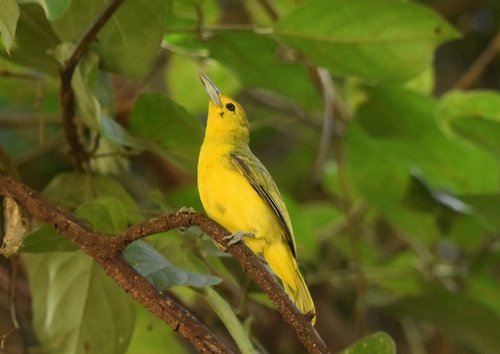
For plumage characteristics, adult females of both A. nigrolutea and A. tiphia are entirely green above, and yellow below—duller yellow in winter and brighter yellow in spring. The only difference in adult female plumage is that A. nigrolutea has a black tail with white central feathers. The juvenile and first-winter plumages of both sexes of both species are similar to the adult female plumage of their respective species. First-year birds can best be identified by their more pointed and somewhat narrower tail feathers.
A. nigrolutea is most commonly recorded from northwestern India. A small number of verified specimen records also exist from southern India, and the species is now also known to occur in Sri Lanka. Some races of common iora A. tiphia can appear similar to A. nigrolutea. Specimens that show nigrolutea-like characters collected within the known range of A. tiphia may simply be variants of A. tiphia; such specimens have been collected from southern Bihar, West Bengal, Khandesh, Tamil Nadu and Mysore. Two adult specimens collected from Gwalior are intermediate between Aegithina tiphia humei and Aegithina nigrolutea, and one specimen from Ceylon (now Sri Lanka) is intermediate between A. nigrolutea and Aegithina tiphia multicolor.
Salim Ali collected one specimen of an Aegithina in the Biligirirangan Hills, which was later commented on by Hugh Whistler. The specimen was a male collected 15 September 1934 at Satyamangala, at an elevation of 2000 feet (600 m). The softness of its skull and narrow tail feathers showed it was an immature bird. It could not be distinguished from A. nigrolutea, because its central tail was washed with white. Whistler stated he could not believe this specimen was truly A. nigrolutea, as the species had never been recorded this far south, with the nearest records being from northern Khandesh and Sambalpur. He instead suggested it was an interesting case of individual variation, which illustrated how A. nigrolutea may have originated.
Whistler's comments on this specimen have been debated since they were published. Daniel Marien noted that the southern boundary of A. nigrolutea's range is not well understood, and added that Biswamoy Biswas had positively identified the Biligirirangan Hills specimen as A. nigrolutea. Walter Koelz collected two adult A. nigrolutea specimens at Salem. Currently, researchers believe the distribution range of A. nigrolutea overlaps significantly with that of A. tiphia.