About Aegires albopunctatus MacFarland, 1905
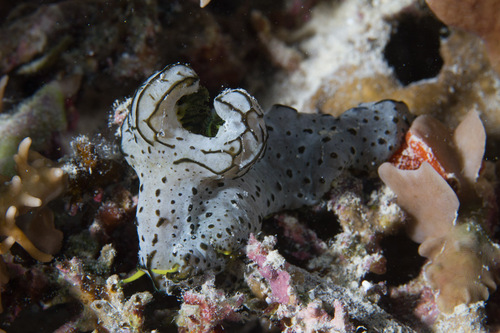
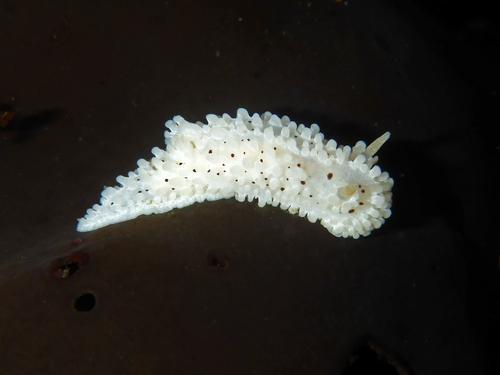
Commonly called the salt-and-pepper doris, this species grows to a maximum length of 0.9 inches (23 millimeters). Its body has a shape somewhat like a squarish torpedo, and its base color ranges from bright white to duller yellowish-gray white. As its common name suggests, this nudibranch is covered in small dark and white spots that resemble mixed ground salt and pepper. The larger dark "pepper" spots are black or dark brown, while the smaller white "salt" flecks are not very distinct on bright white individuals, and are more noticeable on individuals with grayer base color. Some individuals have very few pepper spots, or none at all. Like other species in the genus Aegires, the salt-and-pepper doris has a firm body wall, because it contains spicules from the sponges it eats. Irregular rows of short, cylindrical tubercles line its body. Its rhinophores are yellowish, and are truncated and simple in shape, matching the shape of the body tubercles. It has three small, tripinnate gill (branchial) plumes, and each plume is sheltered by a large, irregularly shaped tubercle. Near its mouth, the salt-and-pepper doris has small, lobe-shaped oral tentacles. A thick, four-sided mandibular plate forms the roof of its mouth, and its radula is broad and deeply grooved, with 16 to 22 rows each holding 17 teeth. This species is found in the Eastern Pacific Ocean, along the coast from British Columbia, Canada to Baja California, Mexico. It lives in the low intertidal zone and shallow subtidal zone, reaching depths down to 100 feet (30 meters). Salt-and-pepper doris can be found in sheltered rocky tide pools and on wharf pilings. Like all nudibranchs, the salt-and-pepper doris is a simultaneous hermaphrodite. When mating, individuals wrestle for dominance, each attempting to penetrate and impregnate the other with its penis, which is covered in small hooked spines.