About Aegiceras corniculatum (L.) Blanco
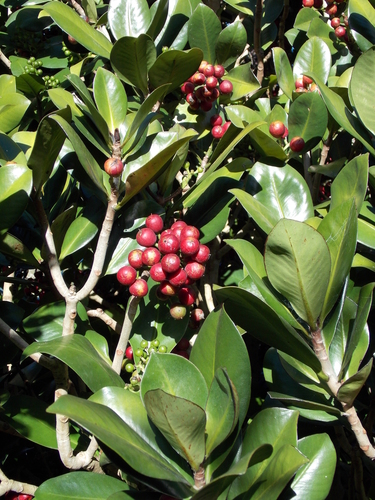
Aegiceras corniculatum (L.) Blanco grows as a shrub or small tree, reaching up to 7 metres (23 ft) tall, though it is often considerably shorter. Its leaves are alternate, obovate, entire, leathery, minutely dotted, 30–100 millimetres (1.2–3.9 in) long, and 15–50 millimetres (0.59–1.97 in) wide. Its small, fragrant white flowers grow in umbellate clusters of 10 to 30 flowers, with a peduncle up to 10 mm long and pedicels 10–18 millimetres (0.39–0.71 in) long. The calyx measures 2–4 millimetres (0.079–0.157 in) long, while the corolla measures 4–6 millimetres (0.16–0.24 in) long. The fruit is curved, cylindrical or horn-shaped, light green to pink in colour, and 20–75 millimetres (0.79–2.95 in) long. This species grows in muddy substrates in estuaries and tidal creeks, most often at the seaward edge of the mangrove zone. It is a species of interest to many moths, including species from the genera Anarsia, Archips, and Phyllocnistis, as well as the species Darna trima, Gonodontis clelia, and Neurozerra conferta. Extract of Aegiceras corniculatum has analgesic properties that support management of diabetes. The stems of the plant contain up to seven identified compounds: 2-methoxy-3-nonylresorcinol, 5-O-ethylembelin, 2-O-acetyl-5-O-methylembelin, 3,7-dihydroxy-2,5-diundecylnaphthoquinone, 2,7-dihydroxy-8-methoxy-3,6-diundecyldibenzofuran-1,4-dione, 2,8-dihydroxy-7-methoxy-3,9-diundecyldibenzofuran-1,4-dione (6), and 10-hydroxy-4-O-methyl-2,11-diundecylgomphilactone.