About Aedes albopictus (Skuse, 1894)
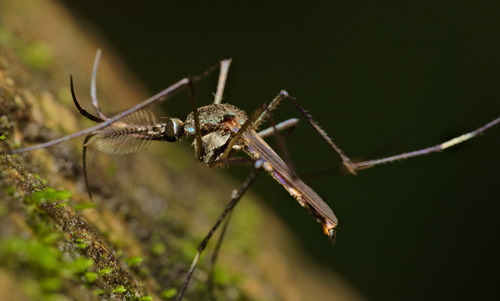
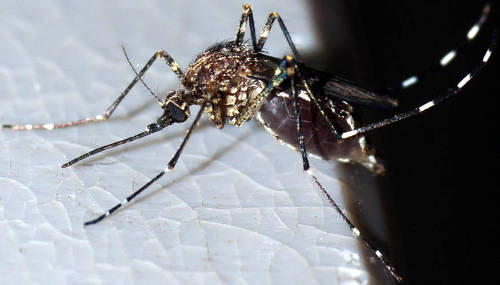
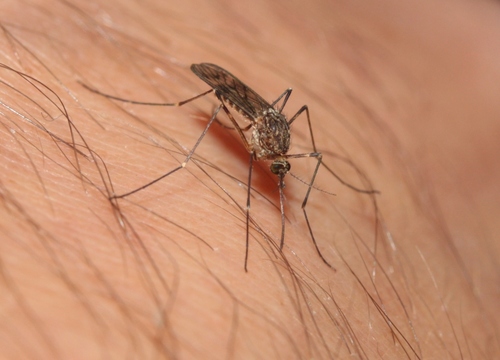
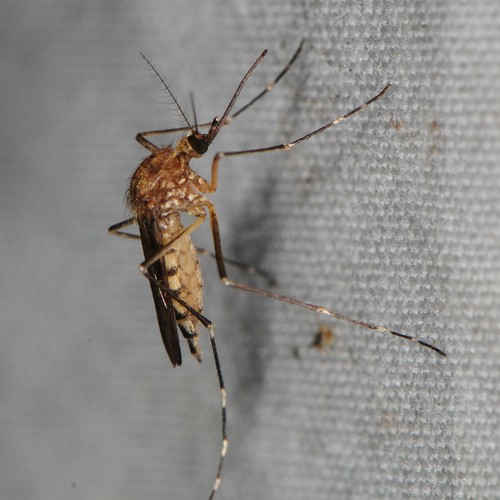
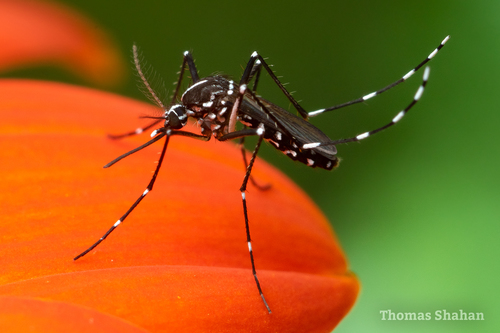
Adult Aedes albopictus, the Asian tiger mosquito, have a total length less than 10 mm, with a distinct black and white pattern. Adult body size varies based on larval population density and food availability in breeding water. These environmental conditions are rarely optimal, so the average adult body size is considerably smaller than 10 mm. Recorded average measurements for this species are 2.63 mm for the abdomen, 2.7 mm for the wings, and 1.88 mm for the proboscis. Males are roughly 20% smaller than females, but the two sexes are very similar morphologically. Like all mosquito species, male Aedes albopictus have noticeably bushier antennae than females; these antennae hold auditory receptors that detect the female's characteristic whine, which is nearly inaudible to humans. Male maxillary palps are also longer than their proboscis, while female maxillary palps are much shorter, a trait typical for males within the subfamily Culicinae. Additional sexual dimorphism is seen in the silver coloration of the hind leg tarsi: male tarsomere IV is approximately 75% silver, compared to only around 60% silver in females. All other visible characteristics are shared between the sexes. A defining, easy to use identifying feature of the Asian tiger mosquito is a single line of tight, silvery-white scales that starts between the eyes and extends down the dorsal side of the thorax. The proboscis is dark colored; the upper surface of the palp's end segment is covered in silvery scales, and the labium has no light line on its underside. The compound eyes are clearly separated from one another. The scute (the dorsal portion of an insect's thoracic segment) is black, alongside the characteristic white midline. Numerous spots covered in white-silvery scales appear on the side of the thorax, the scutellum, and the abdomen. These white-silvery scales are also present on the tarsi, especially on the commonly air-suspended hind legs. The bases of tarsomeres I through IV have a ring of white scales, creating an alternating black and white ringed pattern. On the forelegs and middle legs, only the first three tarsomeres have this white scale ring, while tarsomere V on the hind legs is completely white. Each leg's femur is black, with white scales on the end of the "knee". The femora of the middle legs have no silver line on the base of their upper side, while the femora of the hind legs have short white lines on the base of their upper side. The tibiae are black at the base and have no white scales. The terga on abdominal segments II through VI are dark, and have an almost triangular silvery-white marking at the base that is not aligned with the silvery scale bands on the ventral side of the abdomen. The triangular marking and silvery band are only aligned on abdominal segment VII. The transparent wings have white spots on the base of the costae. In older museum specimens, scales may be partially worn away, making these identifying characteristics less prominent. Like other mosquito species, female Aedes albopictus have an elongated proboscis they use to collect blood to nourish their developing eggs. The Asian tiger mosquito has a rapid bite and is agile enough to escape most people's attempts to swat it. Males, by contrast, feed primarily on nectar and do not bite. Females lay their eggs near water rather than directly in it, typically close to a stagnant pool. However, any open container holding water can support larvae development, even containers holding less than 30 ml (1 US fl oz) of water. This species can also breed in running water, so stagnant pools are not its only breeding site. It is more likely to lay eggs in water sources located near flowers than in water sources with no nearby flowers. It has a short flight range of less than 200 m (220 yd), so breeding sites are typically close to where individual mosquitoes are found. Other mosquito species can be visually confused with the Asian tiger mosquito. Comparing specimens to approved photographs is the most reliable way to confirm a species identification. Behavioral cues including almost-silent flight and difficulty catching, combined with knowledge of the range of locally endemic mosquitoes, can also help with identification.