About Aechmophorus clarkii (Lawrence, 1858)
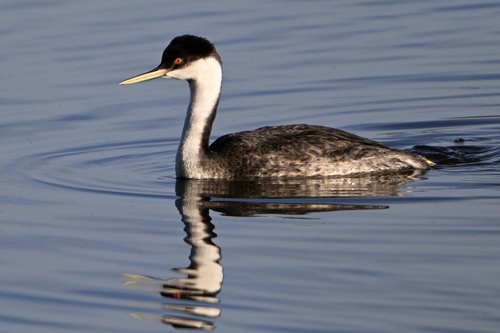
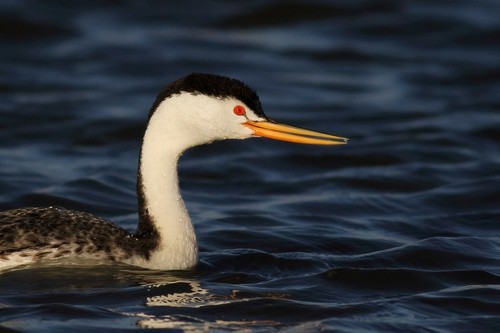
Clark's grebe (Aechmophorus clarkii) closely resembles the western grebe, and the two species often occur together in the same colonies. In 1992, Storer and Nuechterlein, building on earlier morphological work by Storer and other researchers, defined this species as distinguishable from the western grebe by overall paler back plumage, plus a larger area of white on the face that extends above the eyes, rather than only below them. A distinguishing feature is its bill: in the United States, Clark's grebe has a bright yellow bill, while the western grebe has a greenish-yellow bill, a difference that has been noted by other observers. Storer and Nuechterlein also noted in 1992 that Clark's grebe has a slightly upturned bill, compared to the straight bill of the western grebe, a feature that had not been recorded in earlier studies.
This grebe has a long, slender neck, with a total body length ranging from 22–29 inches (56–74 cm), a wingspan of 24 inches (61 cm), and a weight between 25.3–44.4 oz (720–1,260 g). There is little sexual dimorphism; the most notable difference between males and females is a slight crest present on the head of males. Juvenile plumage is similar to that of juvenile western grebes, but is paler than the greyer plumage of juvenile western grebes.
The relative size of Clark's grebe compared to the western grebe is a point of confusion. Dickerman found that grebes from the southern part of the shared range were smaller than grebes from northern populations, regardless of color morph, with both morphs matching in size for a given location. In 1963, Dickerman originally reinstated the name A. clarkii for smaller, southern populations, regardless of color morph. Studies conducted by Storer, Ratti, Mayr and Short between the 1960s and 1970s found no size differences between the two morphs. Despite this, some current publications state that paler-colored grebes are slightly smaller, a discrepancy that may come from confusion with Dickerman's species concept. Under Dickerman's framework, Clark's grebe does not occur in the USA or Canada; pale-coloured grebes in the US and Canada are classified as western grebes, and dark-colored morphs in Mexico are classified as Clark's grebe.
While darker and lighter-colored grebe morphs exist in non-migratory resident populations in Mexico, it is unclear if these can be distinguished by the other morphological characteristics described above, as most studies have only examined populations from the US. Lighter-colored morphs in Mexico are reported to have orange bills, while darker morphs have yellow bills. In winter in California, numerous dark-colored western grebes showed the mostly white face typical of Clark's grebe; these intermediate features are thought to possibly result from seasonal changes.
As waterbirds, Clark's grebes require bodies of water that provide enough food and shelter to thrive, most often lakes or suitable wetlands, located near tree cover they can use for nesting.
Clark's grebes occur seasonally across most of western North America, ranging as far south as Mexico and as far north as British Columbia and Saskatchewan. They avoid cold temperatures, and are only found in central USA and Canada during the summer breeding season. Breeding occurs across a large portion of western USA and Canada, spanning from British Columbia to Texas, where grebes favor larger bodies of water and gather in large flocks. In 1992, Storer and Nuechterlein made a doubtful claim that these birds winter in Central America, as well as in Mexico and some regions of California. Of almost 100,000 records of this taxon logged in the Global Biodiversity Information Facility, there are zero records found south of northern Oaxaca, Mexico. In Mexico, the species' range forms two separate southward streaks. One runs from the California border along the Pacific coast through Baja California, across the Gulf of California and along the coast to southern Sonora. The other is a higher-altitude inland distribution running down from the Big Bend region behind the Texas border through the mountains of central Mexico, with the highest population concentration in the south from Jalisco to Puebla and northern Oaxaca, where the distribution ends abruptly. These two areas where grebes have been recorded only meet in a strip along the USA border in far northern Mexico; further south they remain separated by a very large distance. The species is completely absent from the Atlantic coast.
Clark's grebe appears to have semi-monogamous behavior: individuals stay with a single mate, but as far as is currently known, this pairing may only last for a single breeding season. Unpaired males far outnumber unpaired females. Males stay with their mate until at least a few weeks after their young hatch, and will have multiple sexual partners over their lifetime. It is not well understood if pairs will re-pair in future breeding seasons. Two courtship ceremonies are performed before mate selection and mating: the "rushing ceremony" and the "weed ceremony". The rushing ceremony involves a sequence of performances and advertising dances with a partner. The weed ceremony involves presenting a partner with a bundle of weeds, followed by a different set of dances. Because there are fewer females than males, the female makes the final decision whether to mate, leading to sexual selection within the species. These courtship events occur during spring migration and shortly after arriving on breeding grounds. While interbreeding between Clark's and western grebes is very rare, there have been recorded cases of phenotypic hybrids, birds with plumage similar to both species, mating and producing fertile offspring. It is believed that interbreeding is less likely between non-hybrid individuals from different migrations, as these pairs have a higher chance of failing courtship.