About Adromischus filicaulis (Eckl. & Zeyh.) C.A.Sm.
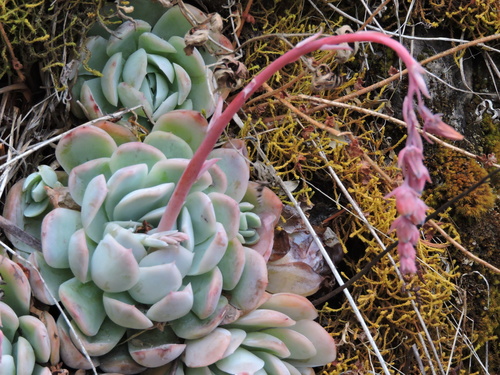
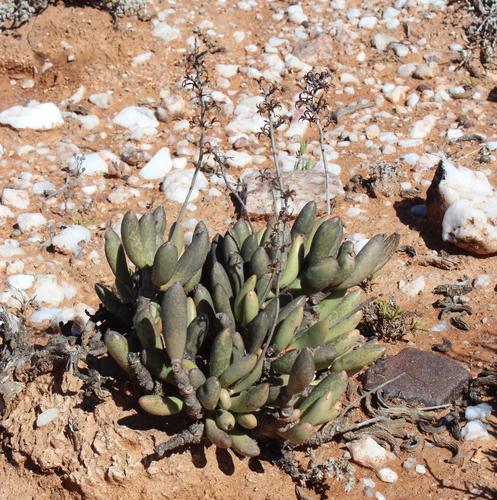
Adromischus filicaulis (Eckl. & Zeyh.) C.A.Sm. includes two described subspecies, with A. f. filicaulis showing wide variation across different localities; some sources suggest the group could be split into more than two subspecies. Plants of this species form small clumps, with growth ranging from upright to decumbent. The short, sparse, upward-growing branches of A. f. filicaulis are grey-brown and reach up to 12 mm in diameter. Some individuals grow compactly, with leaves covering their stems, while others have more spaced-out leaves. The leaves of A. f. filicaulis measure 3 cm to 9.5 cm long and 0.5 cm to 1.7 cm wide. They are oblong, sometimes flattened on their upper face, and have pointed tips. Leaf shape ranges from short and plump to long and slender. The grey-green leaves sometimes bear purple spots. Inflorescences can grow up to 35 cm tall and emerge in mid-summer. The sparse flowers are tubular, with yellow-green sepals that have red-tinged tips. Triangular petals measure 2 mm long and range from white to pink-tinged. A. f. marlothii shows similar variability to A. f. filicaulis, but differs in its growth habit: it grows along the ground, and produces supportive stilt roots (sometimes called aerial roots) that grow from stem nodes and root into the soil below. It is sparsely branched, and sometimes produces upright branches. Both subspecies occur in the Northern Cape, Southern Cape, and the Succulent Karoo of South Africa. A. f. filicaulis can also be found as far north as Namibia. The whole species grows in and near false fynbos. Individuals growing east of Vanrhynsdorp have longer, more slender leaves and straight-growing branches.