About Adiantum capillus-veneris L.
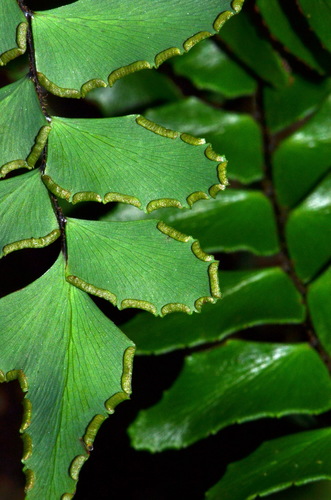
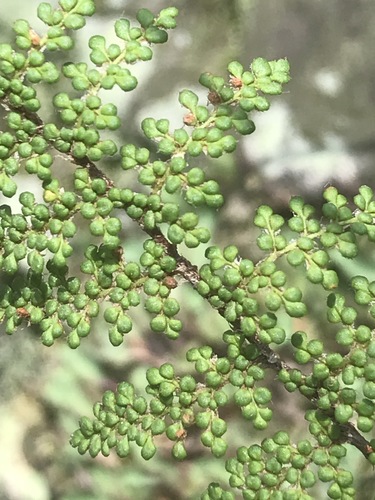
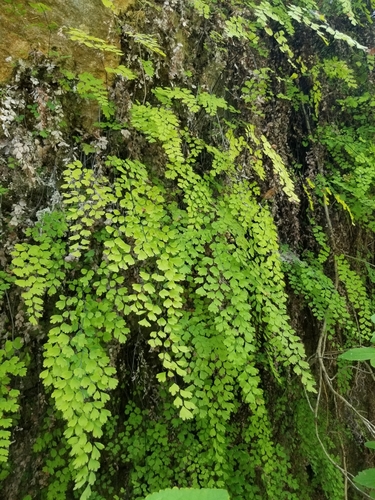
Adiantum capillus-veneris L. reaches 15 to 30 cm (6 to 12 in) in overall height. Its fronds grow in clusters from creeping rhizomes, and reach 20 to 70 cm (8 to 28 in) tall. The fronds are very delicate and light green, heavily subdivided into pinnae that are 5 to 10 mm (0.2 to 0.4 in) long and wide, with a black, wiry frond rachis. This species is native to humid warm temperate through tropical regions across the world. Its range includes western and southern Europe, extending north to southern Scotland, which hosts its northernmost natural sites, much of Africa, the Levant, and all of Asia across to Japan, as well as Australasia, and the Americas from the southern half of the United States (from California to the Atlantic coast) through Mexico and Central America to South America. There are two disjunct populations far north of its main range in northern North America, found at Cascade Springs in the Black Hills of South Dakota and at Fairmont Hot Springs, British Columbia. In both locations, the warm microclimate created by hot mineral springs allows the species to grow this far outside its normal range. The same situation occurs at Zvonce spa resort (Zvonačka Banja), near Pirot in Serbia, where hot mineral springs provide the heat and humidity this species needs to survive. Adiantum capillus-veneris grows in climates from warm temperate to tropical, in sites that have high but not saturated moisture content. It grows in moist, well-drained sand, loam, or limestone across many habitats, including rainforests, shrublands, woodlands, broadleaf forests, coniferous forests, desert cliff seeps, and springs. It is commonly found growing on moist, sheltered, shaded sandstone or limestone formations, which are generally south-facing in the southern hemisphere and north-facing in the northern hemisphere, or located in gorges. It occurs across Africa in moist areas alongside streams. On moist sandstone cliffs, it grows in full or partial shade, even when growing in unprotected sites. Botanists were surprised to discover this fern thriving in the 14th-century underground tunnels of Znojmo, South Moravia. It was first recorded in these tunnels in 2020, and has spread significantly since that time, supported by the area's damp environment and artificial lighting from tourist tours. One theory holds that the fern's spores came from a local houseplant in Znojmo, while another suggests spores traveled from a tropical country. Despite this unusual growing location, the fern is not expected to spread beyond the tunnels or harm native local species. Adiantum capillus-veneris is cultivated and widely available worldwide for planting in natural native plant landscapes, traditional shade gardens, outdoor container gardens, and it is very commonly grown as an indoor houseplant. Adiantum × mairisii is a winter-hardy hybrid of Adiantum capillus-veneris with another Adiantum species, which is likely one of Adiantum raddianum, Adiantum aethiopicum, or Adiantum cuneatum. When grown as a houseplant, Adiantum capillus-veneris requires filtered light and very humid conditions. It should be planted in organic matter-rich soil, and watered frequently but lightly, to keep roots damp without becoming waterlogged. Growing temperatures for this houseplant should not drop below 12 °C (54 °F). It is propagated by dividing the plant, ensuring each divided clump includes a section of rhizome. This plant has documented traditional medicinal uses. Native American peoples use it medicinally: the Mahuna people use it internally to treat rheumatism, while the Navajo people of Kayenta, Arizona prepare a plant infusion as a lotion for bumblebee and centipede stings. Navajo people also smoke this plant or take it internally to treat mental illness. In Iranian traditional medicine, an infusion of the fronds of Adiantum capillus-veneris is used to treat jaundice, and it also has a wide range of other medicinal uses including treating coughs and colds, and supporting kidney function.