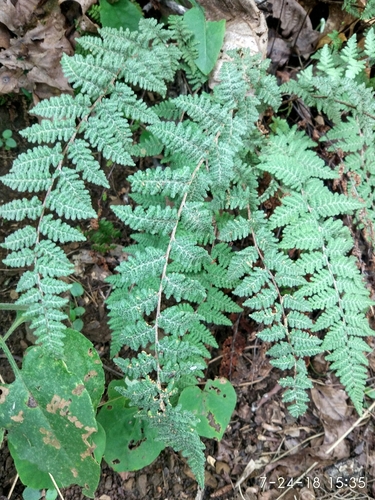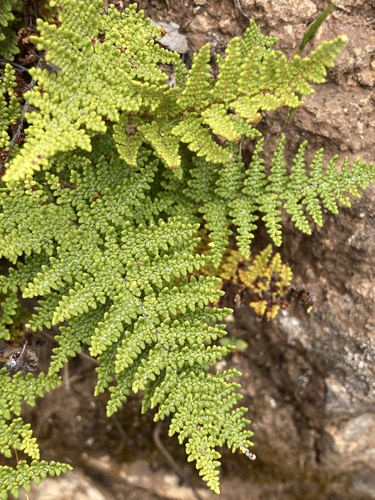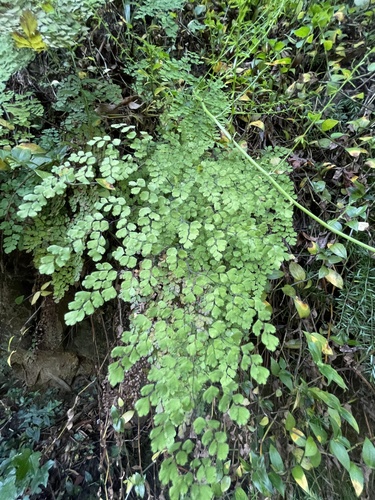
About Adiantum aethiopicum L.
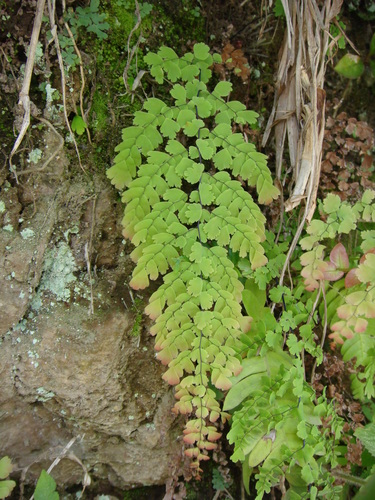
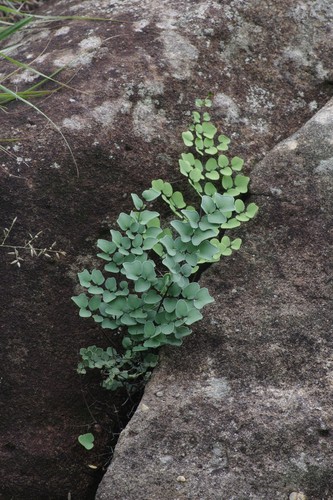
Adiantum aethiopicum, commonly called the common maidenhair fern, is a small fern with a widespread distribution across Africa, Australia, Norfolk Island, and New Zealand. It was one of many species first described by Linnaeus, published in his Systema naturae in 1759. The specific epithet aethiopicum is the Latin term that referred to Africa south of the world that was known at the time, roughly corresponding to Africa south of Egypt. In South Africa, the species occurs widely but is generally not abundant; it grows mainly on moist sandstone cliffs in full shade. In the Cape Peninsula, it is uncommon and grows primarily at the highest local altitudes available, generally between 600–1,085 m (2,000–3,600 ft). This fern grows in spreading clumps of fronds that reach 10 to 45 cm (4 to 18 in) in height. It has wiry, branched rhizomes. Fronds are either horizontal and layered, or upright. Each frond is divided into two or three parts and bears many small wedge-shaped segments; sori grow along the margins of the underside of each segment. It is a common plant, often found growing in moist areas. In Australia, it grows near creeks or in open forest, where it can form large colonies. The 1889 book The Useful Native Plants of Australia notes that this plant is reported to have medicinal properties: it is slightly astringent and emetic. It has been used in Europe to make "Sirop de Capt'llaire," a demulcent drink used to treat chest diseases. As an ornamental plant, Adiantum aethiopicum is popular and widely known. It can be propagated by dividing established plants or from spores. In cultivation, the common maidenhair fern prefers a well-lit position when grown indoors, and a shady, draught-free location when grown outdoors. It is suitable for growing in terrariums and hanging baskets. It is fairly easy to cultivate, and thrives in moist garden soil or potting mix.