About Adenium obesum subsp. swazicum (Stapf) G.D.Rowley
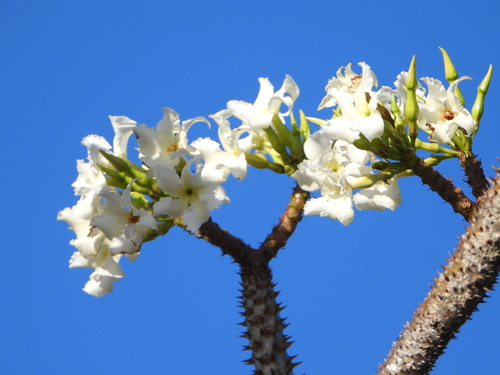
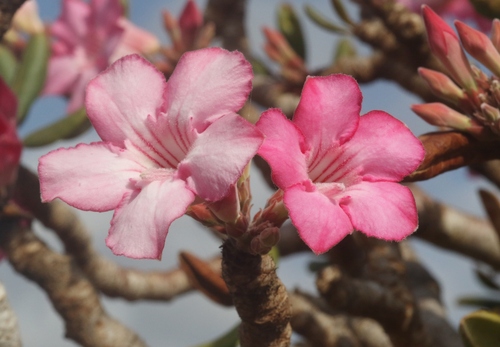
Adenium obesum subsp. swazicum is an evergreen or drought-deciduous succulent shrub; it may also drop its leaves during cold snaps, or leaf drop can vary by subspecies or cultivar. It reaches heights between 0.12–5 m (0.39–16.40 ft), and has disproportionately large pachycaul stems plus a stout, swollen basal caudex, a rootstock that protrudes above the soil surface. Its leaves are arranged spirally, clustered near the tips of shoots, are simple with entire margins, and have a leathery texture. Leaves measure 5–15 cm (2.0–5.9 in) long and 1–8 cm (0.39–3.15 in) wide. The flowers are tubular, 2–5 cm (0.79–1.97 in) long, with an outer diameter of 4–6 cm (1.6–2.4 in) and five petals. The flowers resemble those of related genera such as Plumeria and Nerium, and are typically red or pink, often with a pale whitish blush on the outer portions beyond the flower throat. In ecology, caterpillars of the polka-dot wasp moth (Syntomeida epilais) feed on this desert rose, alongside feeding on oleanders. In regions with consistently warm temperatures year-round, this plant can bloom continuously throughout the year. Adenium obesum produces sap in its roots and stems that contains cardiac glycosides. This sap is used as arrow poison for hunting large game across much of Africa, and also as a fish toxin. In cultivation, Adenium obesum is a popular houseplant and bonsai in temperate regions. It needs a sunny growing location, and a minimum indoor winter temperature of 10 °C (50 °F). It grows well with the dry, xeric watering schedule that cacti require. Adenium obesum is typically propagated by seed or stem cuttings. The many existing hybrids are mainly propagated by grafting onto seedling rootstock. Plants grown from seed are more likely to develop a swollen caudex at a young age, but over time many cutting-grown plants cannot be told apart from seed-grown plants. Like many plant species, Adenium obesum can also be propagated via in vitro plant tissue culture. This plant has been awarded the Royal Horticultural Society's Award of Garden Merit.