About Adenanthos terminalis R.Br.
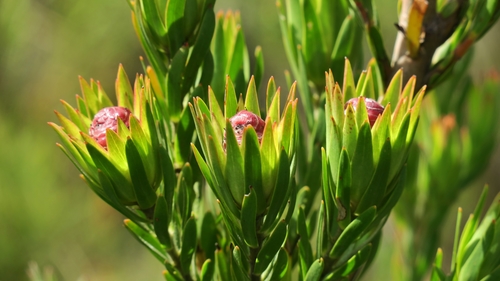
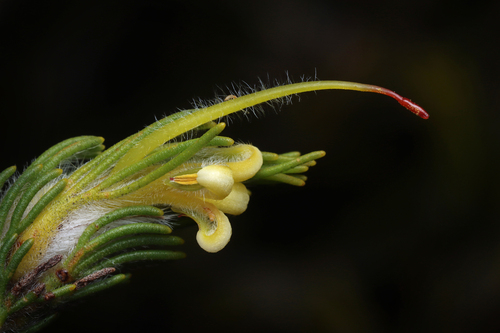
Adenanthos terminalis R.Br. grows as an upright shrub, typically no taller than 1 m (3.3 ft), though it can occasionally reach 2 m (6.6 ft) in height. This species does not form a lignotuber. Its branches grow erect, and are covered in hairs that lie flat against the stem. The leaves are laciniate, segmented into three groups with a total of three to seven long, thin segments (called laciniae); most often there are five segments. Each lacinia is between 5 and 15 mm (0.20 and 0.59 in) long, and around 0.5 mm (0.020 in) in diameter. Most leaves are clustered at the ends of branches, but some remain along the stem. Leaves growing along the stem are mostly hairless and smaller than the bracts surrounding the flowers, which often have long hairs near their bases.
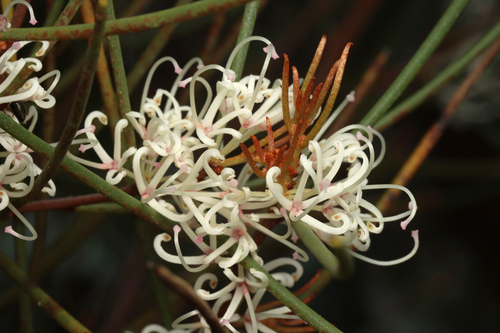
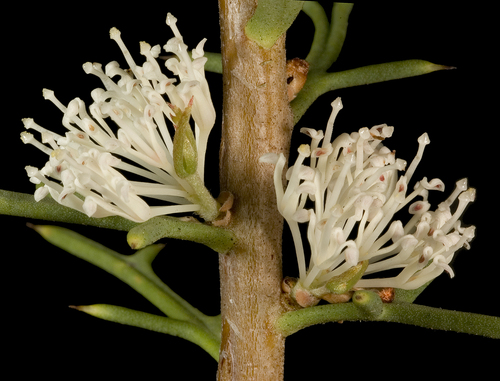
Unlike most other species in the Adenanthos genus, the inflorescence of A. terminalis is not always limited to a single flower: flowers can grow in groups of up to three. The flower clusters are usually hidden by the surrounding floral bracts. Each flower has a perianth up to 16 mm (0.63 in) long, and a style up to 30 mm (1.2 in) long. The perianth ranges from white to cream in colour, sometimes with green tinting, and is covered in short hairs on its outer surface. The style is also almost always hairy, and the ovary is densely covered in hairs.
This species occurs in southern Australia, ranging from the Eyre Peninsula and Kangaroo Island in South Australia to the Big Desert and Little Desert regions of Victoria. Its easternmost distribution is at Wyperfeld National Park, making it the easternmost species of the Adenanthos genus. It grows in deep sandy soils, and sometimes in lateritic soils, within mallee scrub habitat.
In a 1977 study conducted in South Australia, which aimed to gather evidence for the hypothesis that honeyeaters pollinate the flowers they visit, A. terminalis flowers were regularly visited by five honeyeater species: Acanthorhynchus tenuirostris (eastern spinebill), Anthochaera chrysoptera (little wattlebird), Phylidonyris pyrrhoptera (crescent honeyeater), Phylidonyris novaehollandiae (New Holland honeyeater), and Gliciphila melanops (tawny-crowned honeyeater). Pollen of A. terminalis was found on the facial feathers of all these species except Anthochaera chrysoptera, and was also recovered from Melithreptus brevirostris (brown-headed honeyeater). A. terminalis is susceptible to Phytophthora cinnamomi dieback.