About Adelphobates galactonotus (Steindachner, 1864)
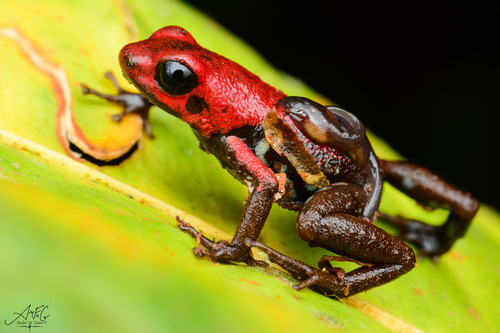
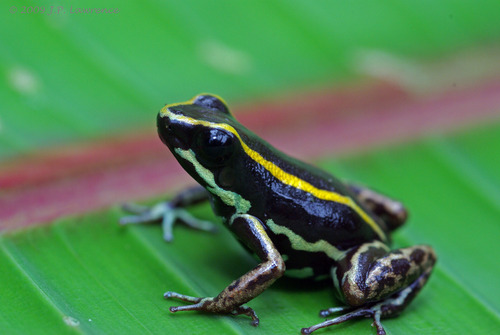
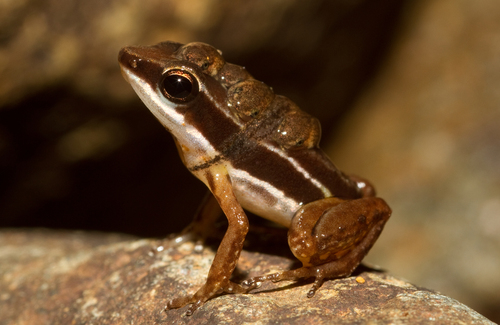
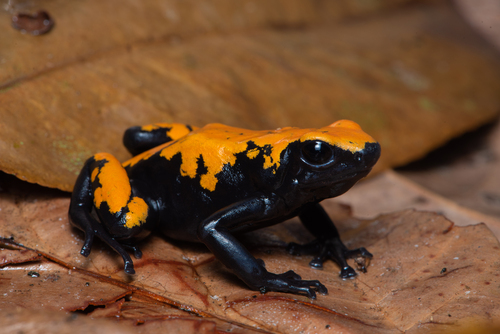
This is a relatively large poison dart frog that reaches a maximum snout-vent length of 42 mm (1.7 in). The most well-known variants of this species are black on their ventral side and yellow, orange, or red on their dorsal side, but the species' coloration is extremely variable. Some morphs have whitish-mint or light blue upperparts, some have a mottled or spotted dorsal pattern, and some are almost entirely whitish (popularly called "moonshine" among captive frog keepers), yellow-orange, or black. It was once speculated that some of these morphs were separate species, but genetic testing found almost no genetic difference between them, even for a distinctive yellow-and-black netted variant from Cristalino State Park. Additionally, the morphs do not have clear geographically separated distributions, which would be expected if they were separate species. This species has often been used as an example by scientists studying the origins of bright coloration in poisonous frogs. A long-standing hypothesis holds that bright coloration is aposematic, acting as a warning to predators that the frog is toxic if eaten. However, studies of this species have found that two of its highly visually distinct color morphs share largely identical poison profiles. These researchers suggest that the species' color variation is more likely tied to conspecific recognition and sexual selection than to predator deterrence. The natural habitats of Adelphobates galactonotus are tropical moist lowland forests, and it has been observed at elevations up to 600 meters above sea level. It appears to prefer forest habitats with a high abundance of Brazil nut trees. The species lays its eggs on the ground. After the eggs hatch, adult frogs carry the tadpoles to water; scientists hypothesize this frequently includes water that has collected inside Brazil nut husks. The frog's known range covers many protected areas.