About Adelges tsugae Annand, 1924
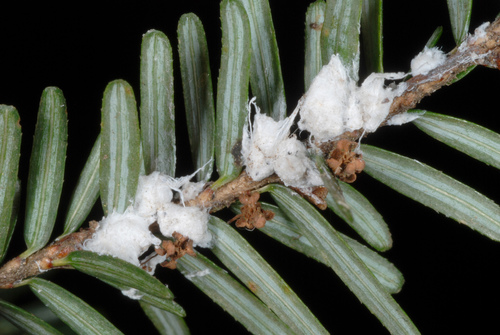
Adelges tsugae Annand, 1924, commonly called hemlock woolly adelgid (HWA), is a tiny insect. Adult individuals are typically 0.8 mm long, oval-shaped, and brown in color. They have four thread-like stylets bundled together to form their mouthpart. This stylet bundle is three times the length of the insect’s body, and it pierces the parenchymatic ray tissue of host hemlock trees to obtain nutrition from the tree’s stored reserves. While feeding, the adelgid may also inject a toxin into the tree. The desiccation that results from this feeding causes infested hemlocks to lose needles and stop producing new growth. Infested hemlocks often turn grayish-green, instead of the healthy dark green color of uninfested trees. In the northern part of the hemlock’s range, infested trees typically die 4 to 10 years after initial infestation. Trees that survive the direct effects of infestation are usually weakened, and often end up dying from secondary causes. The presence of HWA can be identified by its egg sacs, which look like small tufts of cotton clinging to the underside of hemlock branches. In North America, hemlock woolly adelgid reproduces asexually, and can produce two generations per year. Both of these generations are parthenogenetic and consist entirely of females. In the species’ native Asian habitat, a third, winged generation called sexupera occurs. Sexual reproduction in this generation requires a species of spruce that does not grow in the Eastern United States. Each individual adelgid lays between 100 and 300 eggs inside the woolly egg sacs located under hemlock branches. Larvae hatch in spring, and can spread on their own, or be carried by wind, birds, or mammals. In the nymph stage, the adelgid is immobile, and settles permanently on a single tree.