About Adelges abietis (Linnaeus, 1758)
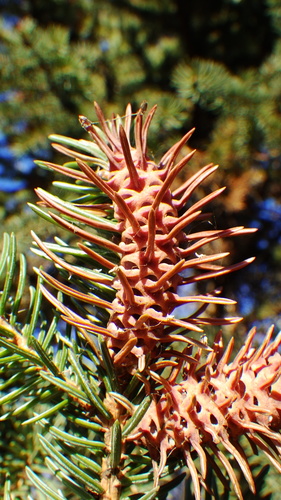
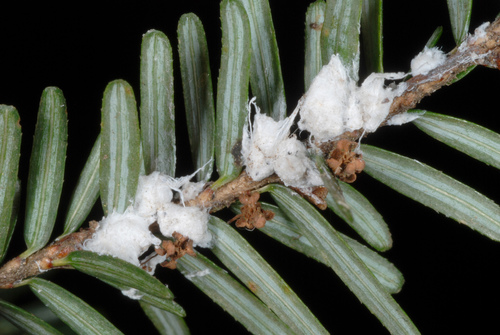
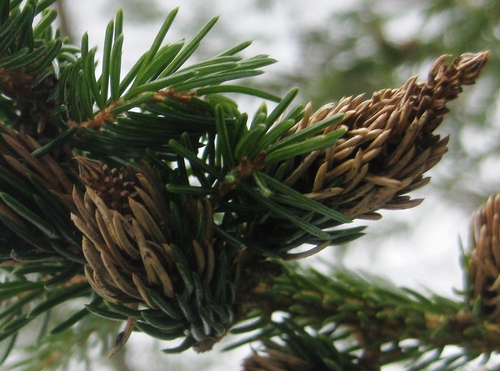
Adelges abietis (Linnaeus, 1758), commonly called the pineapple gall adelgid, is a conifer-feeding insect known for forming pineapple-shaped plant galls on its host trees, most commonly Norway and Sitka spruce. Members of the genus Adelges, the adelgids this species belongs to, are pear-shaped, soft-bodied green insects with long antennae, and are closely related to aphids. Females of this species lay up to 100 eggs, with one egg per needle. It is one of the most common species in the genus Adelges, and has accepted synonyms: A. gallarum-abietis, Chermes abietis and Sacciphantes abietis. The pineapple-shaped gall, also called a pseudocone gall, is an insect-formed abnormal outgrowth of plant tissue that develops when the insect chemically distorts spruce needles. These galls are prominent, and often confused with the tree’s actual cones due to superficial similarity. They can be distinguished by their small size, their location at the base of budding twigs, and the characteristic of the host branch growing through and extending past the gall. The pineapple gall adelgid is endemic to Europe, belongs to the woolly adelgid group, and is widely distributed in the north-eastern United States. It also has several common alternative names: spruce gall aphid, eastern spruce pineapple adelgid, and eastern spruce gall aphid. This species falls within the superfamily Aphidoidea and family Adelgidae, and is the primary pest of Norway spruce. A related North American indigenous species, the Cooley spruce gall adelgid, typically infests Colorado Blue, Sitka, Englemann, and Oriental spruces. The eastern spruce gall adelgid, another common name for Adelges abietis, is an introduced species that feeds only on spruce. As of 1985, the species had been recorded in Canada from Ontario eastward, and in adjacent areas of the United States. Only female pineapple gall adelgids have been documented. Overwintered eggs hatch into new nymphs in spring; these nymphs feed at the base of growing needles. The chemically induced swellings caused by feeding eventually merge to form the pseudocone gall structure, and each cell of this gall holds approximately twelve nymphs. Nymphs of this species overwinter under wax threads at the base of host buds. Between July and September, in late summer, fully developed nymphs emerge from the galls, crawl out onto spruce needles, molt, and develop into winged adults. These winged adult adelgids may fly to other susceptible conifers, including larch (Larix), pine (Pinus) and silver fir (Abies alba), or may remain on the same tree, as some individuals are poor fliers. Adults die shortly after reaching maturity, leaving their eggs protected beneath their bodies; the eggs have a visual resemblance to white, cottony twigs. Multiple generations of the insect develop on these non-spruce secondary hosts, and no galls form on these hosts. In July of the following year, a new generation of winged adelgids emerges and flies back to spruce trees to breed, completing the species' full life cycle.