About Adela cuprella Thunberg, 1794
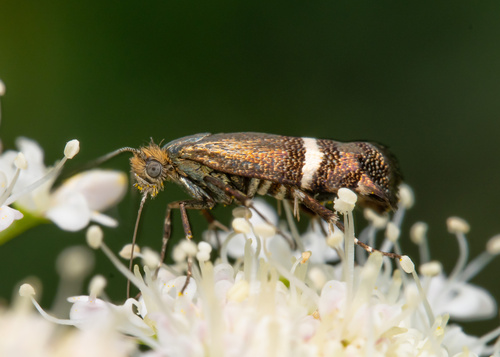
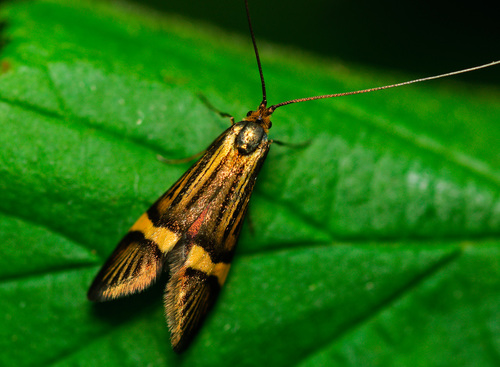
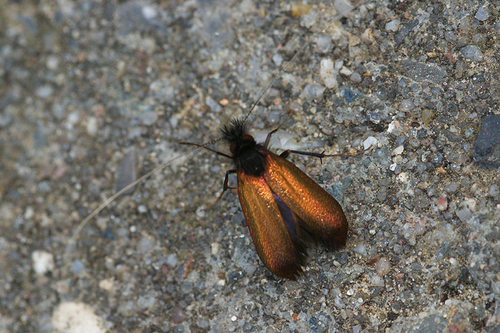
Adela cuprella Thunberg, 1794 has a wingspan of 14 to 17 millimeters. Male moths have black heads, while female moths have ferruginous heads and hairy faces. Male antennae are 2.5 times the length of the forewing, are white, and have blackish rings toward the base. Female antennae are 1.25 times the length of the forewing, are black and not thickened, and are white toward the apex. The hindwings are purple-fuscous. Adult Adela cuprella are active during the day. They are on wing from mid-April to early May, and fly around willows. This species is found across most of Europe, with the exception of Portugal, Slovenia, and most of the Balkan Peninsula. Adela cuprella is univoltine, meaning it produces one generation per year. Adult moths visit the flowers of sallows, usually in the upper sections of the plants. Populations can be numerous in some years, and scarce or absent in others. Females lay their eggs on the catkins of sallows. The larval case is elongate-oval, and each half of the case is constructed from several roughly crescentic pieces of dead sallow leaves. Larvae begin feeding in May, and can overwinter two or three times. Pupation occurs inside the larval case in March.