About Addax nasomaculatus (Blainville, 1816)
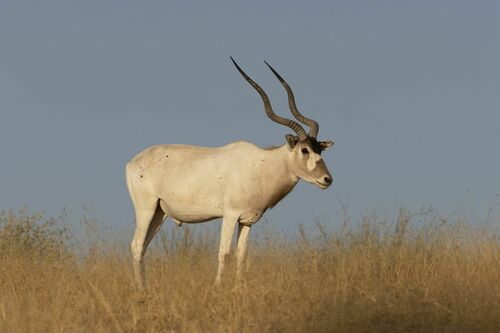
The addax (scientific name Addax nasomaculatus) changes its coat color with the seasons: it is greyish-brown in winter and nearly entirely white or sandy blonde in summer. It has white hindquarters and legs, and long brown hair covering the head, neck, and shoulders. Adult addax measure 120 to 130 cm (47 to 51 in) from head to body, with a 25 to 35 cm (9.8 to 13.8 in) long tail. This species shows sexual dimorphism in size: males stand 105 to 115 cm (41 to 45 in) tall at the shoulder and weigh 100 to 125 kg (220 to 276 lb), while females stand 95 to 110 cm (37 to 43 in) tall and weigh 60 to 90 kg (130 to 200 lb). Brown or black patches on the head form an X shape over the nose. Addax have scraggly beards and distinct red nostrils. Long black hair grows between their curved, spiraling horns, and extends down the neck as a short mane. Their horns have two to three twists, and are typically 55 to 80 cm (22 to 31 in) long for females and 70 to 85 cm (28 to 33 in) long for males; the maximum recorded horn length is 109.2 cm (43.0 in). The lower and middle sections of the horns have 30 to 35 ring-shaped ridges. The short, slender tail ends in a puff of black hair. Broad hooves with flat soles and strong dewclaws help addax walk on soft sand, and all four feet have scent glands. Addax can live up to 19 years in the wild, and up to 25 years in captivity. The addax looks very similar to the scimitar oryx, but can be told apart by its horns and facial markings. Unlike the addax's spiral-shaped horns, scimitar oryx have decurved horns that reach 127 cm (50 in) in length. The addax has a brown hair tuft that runs from the base of its horns to between its eyes, and a connected white patch that extends to the middle of the cheek. By contrast, the scimitar oryx has a white forehead with only one prominent brown marking: a brown lateral stripe across its eyes. Addax differ from other antelopes in having large, square teeth similar to cattle, and lacking the typical facial glands found in other antelope species. Addax live in arid regions, semideserts, and both sandy and stony deserts. They can survive in extremely dry areas that receive less than 100 mm (3.9 in) of annual rainfall. They also inhabit deserts that contain tussock grasses of the genus Stipagrostis and succulent thorn scrub of the genus Cornulaca. Historically, addax were widespread across the Sahelo-Saharan region of Africa west of the Nile Valley, present in all countries that share the Sahara. Today, the only known self-sustaining wild population lives in Niger's Termit Massif Reserve. Sightings have been reported from the eastern Air Mountains in Niger and Bodélé in Chad. Rare nomadic individuals may be seen in northern Niger, southern Algeria, and Libya. The species is rumored to occur along the Mali/Mauritania border, though no confirmed sightings have been made there. Addax were once abundant across North Africa, and were native to Chad, Mauritania, and Niger. It is now extinct in Algeria, Egypt, Libya, Sudan, and the Western Sahara, but has been reintroduced to Morocco and Tunisia. Addax herds include both males and females, and typically have 5 to 20 members. They generally stay in a single area, only roaming long distances to find food. Herds are usually led by one dominant male. In captivity, males display territorial behavior and mate guarding, while captive females form dominance hierarchies where the oldest females hold the highest rank. Herds tend to stay along the northern edge of the tropical rain system during summer, and move north as winter arrives. Addax can track rainfall, and travel to these wet areas where vegetation is more abundant. Males are territorial and guard females, while females establish their own dominance hierarchies. Because addax move slowly, they are easy targets for predators including humans, lions, leopards, cheetahs, and African wild dogs. Caracals, servals, and hyenas prey on addax calves. Addax are usually not aggressive, though individual animals may charge if disturbed. Female addax reach sexual maturity at 2 to 3 years old, while males mature sexually around 2 years old. Breeding can happen year-round, but peaks in winter and early spring. In the northern Sahara, breeding peaks at the end of winter and start of spring; in the southern Sahara, breeding peaks from September to October and from January to mid-April. Each estrus period lasts 1 to 2 days. One study analyzed blood serum from female addax using immunoassay to study the luteal phase, finding the estrous cycle lasts approximately 33 days. During pregnancy, ultrasound shows coiled uterine horns. The maximum diameter of the ovarian follicle is 15 mm (0.59 in), and the maximum diameter of the corpus luteum is 27 mm (1.1 in). Each female has an anovulatory period that lasts 39 to 131 days, during which no ovulation occurs. Anovulation is rare in winter, which suggests seasons affect the estrous cycle. Gestation lasts 257 to 270 days, or about nine months. Females may give birth either lying down or standing, and only one calf is born per pregnancy. A postpartum estrus occurs 2 to 3 days after delivery. Calves weigh 5 kg (11 lb) at birth, and are weaned at 23 to 29 weeks old.