About Adalaria proxima (Alder & Hancock, 1854)
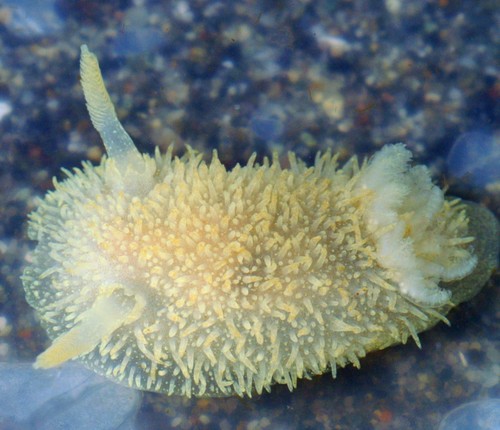
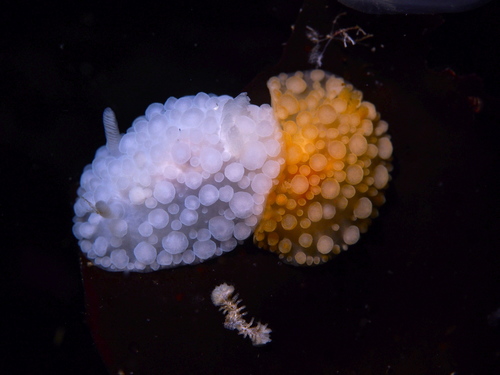
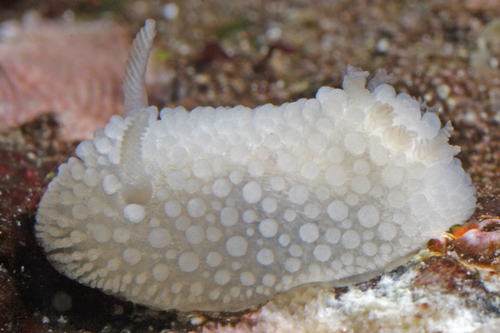
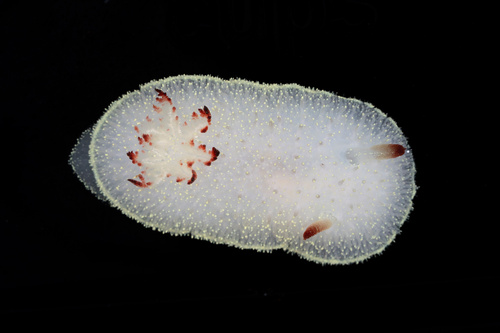
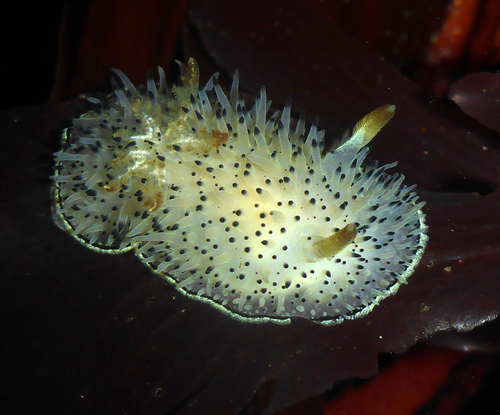
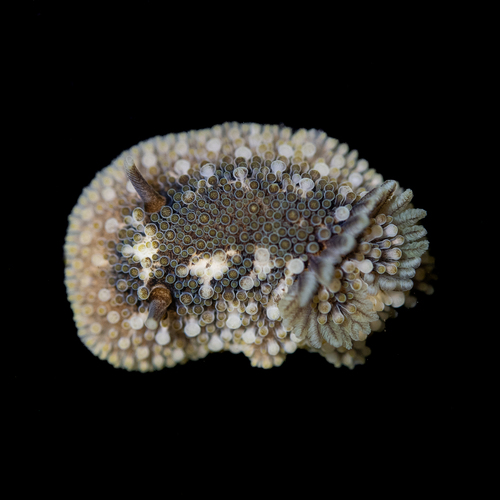
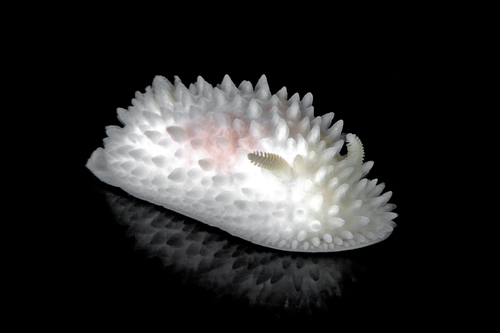
Adalaria proxima (Alder & Hancock, 1854), also referred to as Onchidoris proxima, has an oval shape and reaches an adult length of around 25 millimeters (1 inch). Above its mouth, the head bears a flattened piece of tissue. Its mantle is covered in club-shaped, pointed-end tubercles stiffened by calcareous spicules, which are spine-like structures. The body is yellowish-orange, and is often a pale shade, particularly in the northernmost areas of this species' range. The blunt-ended rhinophores, which are sensory tentacles located on the head, are commonly darker than the rest of the body, and each rhinophore carries up to nineteen thin plates. A ring of approximately twelve feathery gills surrounds the anal papilla. This species can be mistaken for Onchidoris muricata, but Onchidoris muricata is typically smaller and paler, and has flattened tips on its dorsal tubercles. This species was first described from Birkenhead, located on the Irish Sea coast of England. It is native to the colder regions of the north Atlantic Ocean. Its range extends from the North Sea, Baltic Sea and White Sea to eastern Greenland, and along the eastern coast of North America as far south as Massachusetts. It has also been recorded in the northern Pacific Ocean, ranging from British Columbia to South Korea. This species occurs between 0 meters and 60 meters (200 feet) deep. Onchidoris proxima feeds primarily on the colonial bryozoan Electra pilosa, which is frequently found growing encrusted on the fronds of large brown algae including Laminaria and Fucus serratus. When Electra pilosa is not available, it will also feed on other bryozoan species: Membranipora membranacea, Alcyonidium polyoum, and Flustrellidra hispida. Breeding occurs in late winter and spring. During this time, females lay eggs in coiled arrangements. The eggs are relatively large, and hatch after approximately forty days. The hatching larvae have a yolk sac, do not feed, drift as part of the plankton, and eventually settle in suitable habitat.