About Adaina montanus (Walsingham, 1880)
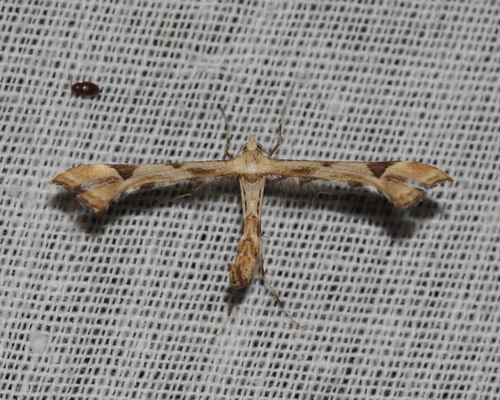
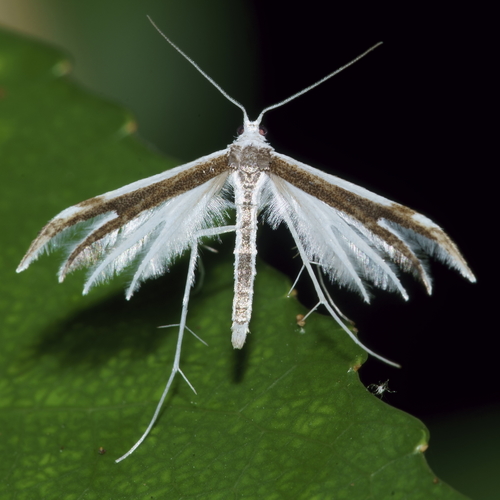
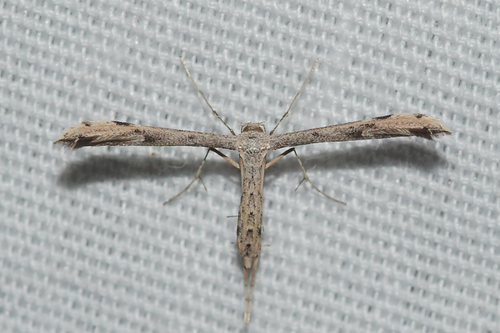
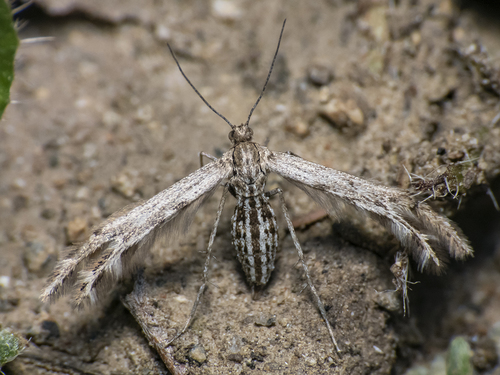
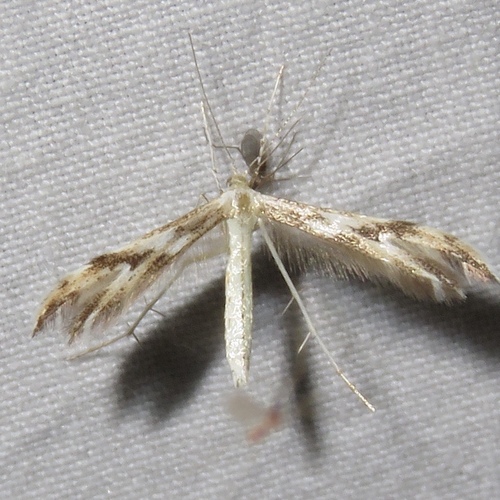
Adaina montanus is a moth species belonging to the family Pterophoridae. It occurs in North America, specifically in southeastern Canada and the northeastern United States. The wingspan of this moth measures approximately 16 mm. Its head is white, and the upper side of its antennae have faint brownish dots. The thorax, abdomen, and legs are snow white, though the inner sides of the fore and middle legs are brownish. The forewings are snow white, scattered with ferruginous-brown scales, with the highest concentration of scales on the outer half of the costa. A patch of these brown scales sits before the base of the wing cleft, extending diagonally to a darker brown spot on the costa that is nearly connected by a dark shading to an additional brown costal spot near the wing apex. A fine dark brown streak runs along the outer half of the costa of the second wing lobe, continuing through the fringe below the apex. All other fringe on the wings is snow white. The hindwings are dusted with ash-grey brown. Adult Adaina montanus have been recorded active in the month of July. The larvae feed on Xanthium strumarium canadense and Symphyotrichum novi-belgii. Young larvae are found on the undersides of their host plant's leaves, while older larvae can also be found on the leaf uppersides. Young larvae consume leaf parenchyma tissue, leaving the leaf epidermis intact. First instar larvae are completely white aside from their claws and mandibles. Later larval instars are pale green, with the eighth and ninth abdominal segments yellow. When fully grown, larvae are pale pea green with a paler head and a dorsal stripe made up of three white lines; the seventh, eighth, and ninth abdominal segments are yellow. Pupation occurs inside a light green pupa, and some pupae have a reddish stripe running along the dorsal portion of the abdomen.