About Acytolepis puspa (Horsfield, 1828)
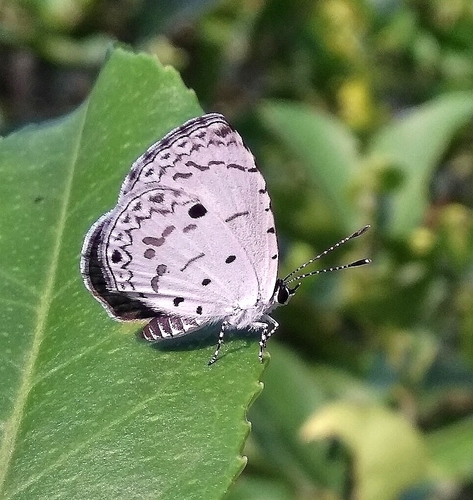
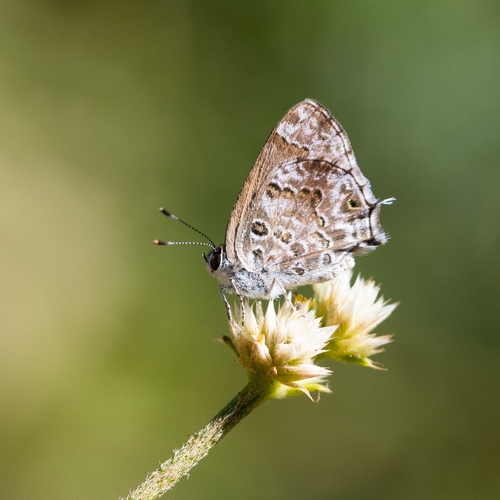
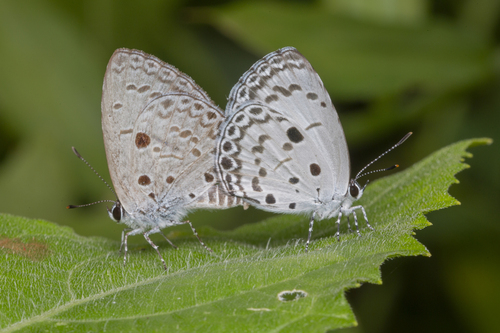
This description covers Acytolepis puspa, split by wet-season and dry-season broods, with separate details for male and female wet-season individuals. For the wet-season brood male: The upperside is violaceous blue, with brilliant iridescent tints visible in certain lighting. On the forewing, the costa, apex, and termen are bordered with black. This black edging narrows from the base to the middle of the costa, then broadens greatly at the apex where it covers the apical fourth of the wing. It narrows again below vein 4, continuing as an even band to the tornus. Beyond the apex of the cell on the disc, the ground colour is noticeably paler, and the dark cell markings are faintly visible through transparency from the underside. On the hindwing, the costa is very broadly black, while the termen is much more narrowly black. The black bordering on the termen is made of a series of rounded coalescent spots, which are margined on the inner side by faint dark lunules; these lunules are not formed by actual scaling, but instead form when dark underside markings show through with varying clarity. The underside is slightly bluish white, with all markings large and distinct, some black and some dusky. On the forewing, there is a short bar on the discocellulars, and an anteriorly inwardly curved, transverse discal series of seven more or less elongate spots: the spot in interspace 2 is vertical and sinuous, the next spot above it is irregularly oval and obliquely placed, the next is smaller and almost round, the fourth is placed almost longitudinally and forms a short bar, and the three apical spots decrease in size towards the costa. Beyond these are an inner subterminal transverse lunular line, an outer subterminal series of transverse spots, and a very slender anteciliary line. On the hindwing, there are two basal and three subbasal spots arranged vertically; a line on the discocellulars; a spot above it at the base of interspace 6; a much larger spot above that in interspace 7; a lower discal irregular transverse series of five spots, followed by terminal markings similar to those on the forewing, except that the spots in the subterminal row are rounded rather than transverse. The cilia of both forewings and hindwings are white, alternating with dusky black at the apices of the veins. The antennae, head, thorax, and abdomen are dusky black, with the antennae ringed with white; on the underside, the palpi, thorax, and abdomen are white. For the wet-season brood female: The upperside is white, with the bases of the wings, and in some specimens the posterior area of the hindwing, shot with iridescent blue. On the forewing, the costa, apex, and termen are broadly black; the discocellulars are marked with a very short, fine black line that extends downward from the black on the costal margin. On the hindwing, the costa and apex are broadly black; below vein 6, the termen has a regular subterminal series of black spots in the interspaces, enclosed within an inner lunular black line and an outer straight slender anteciliary black line; all veins except the middle vein 5 are slenderly black. The cilia of both forewings and hindwings are white. The ground colour and markings of the underside match those of the male, and the antennae, head, thorax, and abdomen are the same as in the male. The dry-season brood differs only very slightly from the wet-season brood. In males, a small white patch is present on the forewing upperside beyond the cell, and on the anterior portion of the disc on the hindwing upperside; the extent of this patch ranges from just a faint touch of white just beyond the cell on the forewing, to a large, diffuse, ill-defined-margined white discal area. In females, the blue iridescence at the base of the upperside wings is considerably restricted in some specimens, and completely absent in others. For both sexes, the underside ground colour is paler than that of the wet-season brood, and the markings are much less prominent in form and position, though they are otherwise identical to wet-season brood markings. This butterfly is found in Peninsular India, Himalayas, Assam, Andamans, Nicobars, Sri Lanka, Cambodia, Myanmar, Taiwan, Philippines, Borneo, Sulawesi and New Guinea. Larvae have been recorded feeding on Glochidion fortunei, Rhododendron species, Distylium racemosum, Rosa multiflora, Rosa wichuraina, Rosa centifolia, Prunus zippeliana, Glochidion obovatum, Myrica rubra, Quercus phillyraeoides, Celtis sinensis, Astilbe thunbergii, Schleichera oleosa, Hiptage benghalensis and Xylia dolabriformis.